Petty Cash
Exetel asked for petty cash. Telstra, a total stranger, had views.
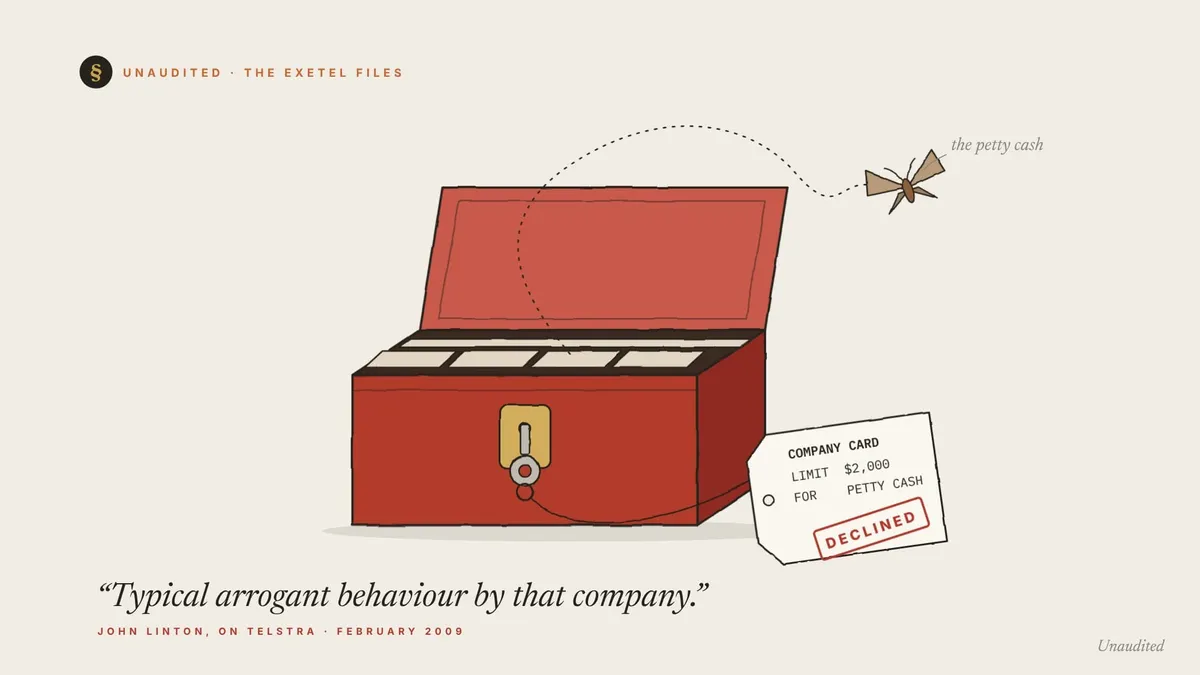

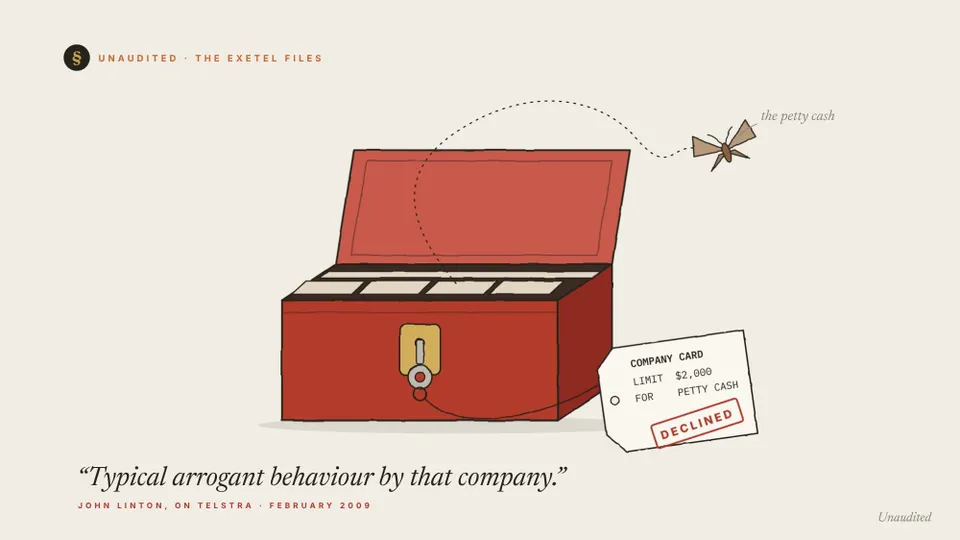
A company asks the bank its founders have used for thirty years for a credit card with a $2,000 limit, for petty cash. The bank says no.
In early 2009 the company was Exetel. By John Linton’s count, it had traded for fifteen years and never paid a bill late. Its credit file carried three defaults, worth less than $700 between them, lodged by Telstra. Exetel had no contract with the part of Telstra that lodged them.
Telstra agreed to take them off within days, without apologising. Fourteen months and one Federal Court claim later, it bought space on page 16 of The Australian to say the entries had been incorrect. It said it had relied on a third party.
Linton called it mealy mouthed. By consent, the court ordered Telstra to pay Exetel’s costs.
Whether Exetel ever went back for the card, the blog does not say.
The Card
As set out in Ten Cents, John Linton had a low opinion of Telstra and a high opinion of paying his bills.
He was proud of the second one. In early February 2009 he explained, at length, that Exetel had “always paid every creditor’s bill in full and mostly before time for the whole of the 15 years of Exetel’s trading existence,” along with every tax return, payroll tax return, superannuation contribution and PAYG instalment, in full and on time.
He was careful to say this was not virtue.
“We did/do this not because we are exemplary citizens but because it’s essential for our start up business not to have any negatives associated with our financial dealings.”
So he had never looked at Exetel’s credit report. There was no reason to.
Then his wife Annette, who had co-founded Exetel with him, told him the bank had said no.
Exetel had asked Westpac, the bank he and Annette had used for thirty years, for a company credit card with a $2,000 limit, so the financial controller could pay for small purchases without staff using their own cards. Exetel was putting more than $4 million a month through its Westpac account, by Linton’s account, and had never run an overdraft, which is the sort of customer a bank would ordinarily trust with the milk money.
“To say I was shocked/jolted/lost for words would be an understatement.”
This post is for subscribers only
Linton’s Musings
He arrived in Sydney before his eighteenth birthday, alone. By his own description he was “a spoiled brat from an elitist English public school,” and it took a while to become something resembling a contributing member of the areas he lived in, starting with Maroubra.Decades later he spent two years setting up TPG’s internet business, and was ‘promised’ a shareholding. He co-founded Exetel with Annette and Steve, his last attempt at delivering some value to the country.For four and a half years he wrote about it almost every working day. He made Telstra apologise in The Australian. He took the Ombudsman to the Federal Court. He paid his Colombo engineers three times the going rate and published their degrees. He bought TPG at ten cents, the company that once promised him a shareholding, and admitted in writing he had been spectacularly wrong before.Not, on the whole, very often.His last post went up on 1 February 2012. It’s the people, stupid, he wrote. Then he wished he was much better at his job, and a lot younger.Superloop got the desks, and now hands out fruit and nuts on Mondays and Wednesdays. Unaudited got the blog.He left 1,600 posts, and Unaudited is still reading.
“It is heartening to see people enjoying his blog again, almost 15 years after I last got to read a new post each morning.”James Linton, CEO of Yomojo, and John’s son