Ten Cents
The only consulting fee in Australian history the consultant paid for.
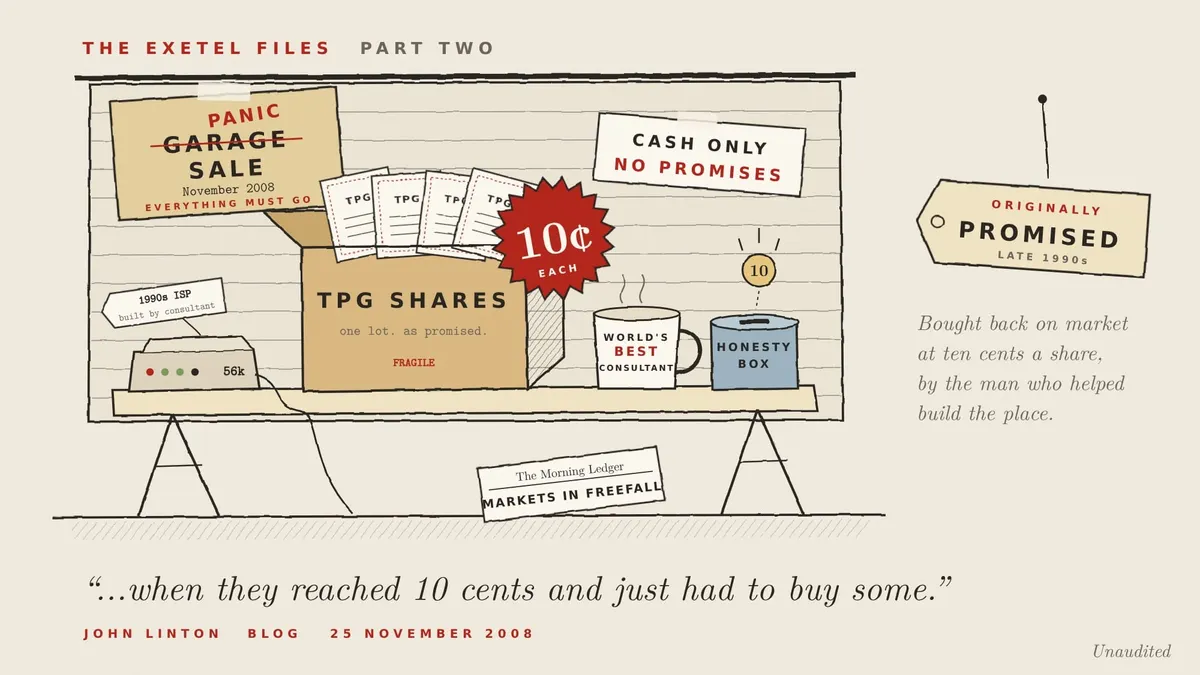
A man at a Saturday garage sale picks up a dusty box marked ten cents, hands over a coin without haggling, and is in the car before anyone thinks to look inside.
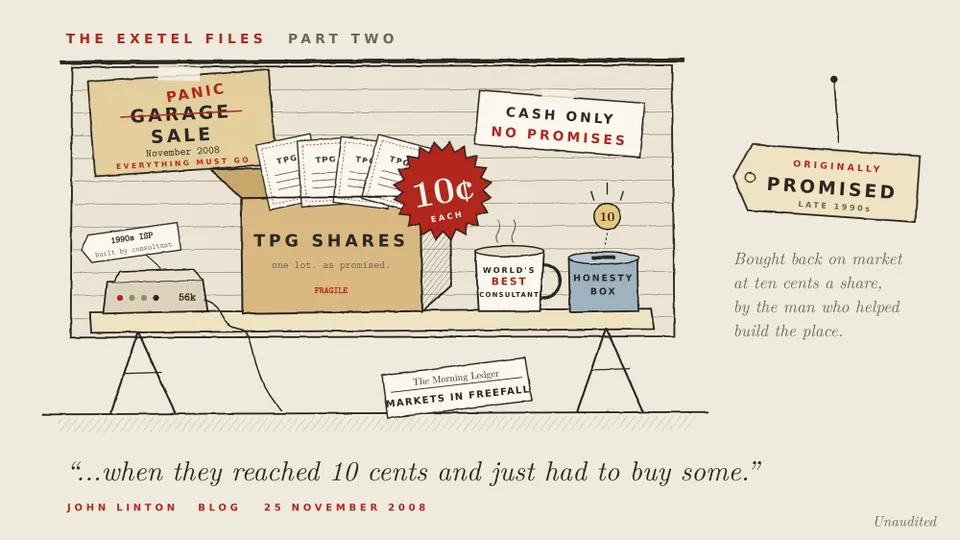
On 24 November 2008, TPG closed at 9.5 cents. By Linton’s reading of the guidance it was heading for more than $90 million in profit that year, and the market valued its equity at about $65 million. The next day John Linton, who had helped set up TPG’s internet business in the 1990s, wrote that he could not resist any longer and had bought at ten cents.
By July 2013 the shares were $3.65 and the Teohs were billionaires. In 2020 the TPG name went to Vodafone. In 2025 the fibre went to Vocus.
The man at the garage sale had the right box. He sold it a bit early, and was not around to watch the next owners put most of it back out on the trestle table.
The Consultant
As set out in Mondays and Wednesdays, John Linton founded Exetel, a TPG competitor, and wrote a blog every working day from July 2007 until the morning he died in February 2012.
In September 2009 he mentioned, almost in passing, that he had spent two years a long time ago “setting up TPG’s internet and business data services.” That business went on to become the core of the company the Teohs got rich on.
He mentioned it the way other people mention a summer job.
He was not, as a rule, generous about other people in the industry. Exetel’s relationship with Telstra was “a ‘marriage’ from Hell,” iiNet’s claims were “an even more embarrassing lie than it ever was,” and Dodo would “go broke sometime this year.” David Teoh was the exception, and he said so plainly.
“David Teoh, who was the best person I have ever met in Australian business in terms of the ability to understand future market trends and opportunities and the ability to hire, and fire, really excellent people who could help him make the most of those opportunities.”
Then, because he was John Linton, he kept going.
“…he also exercised a level of financial control at a micro detail level that would make Ebenezer Scrooge look like the Rockefeller Charity Foundation.”
From Linton, that was a compliment, possibly the warmest one in four and a half years of posts.
The Sale of the Century
In February 2008, Teoh sold TPG into SP Telemedia, the listed company better known as Soul. Linton read the ASX announcement in Singapore and put the price at effectively a quarter of a billion dollars, $150 million in cash and almost 40 per cent of the merged company.
He called it “a truly great reward for 22 years of deeply insightful, well executed and tough minded operation.” TPG was bringing 200,000 ADSL customers, 220 DSLAMs, $150 million in sales and $50 million in EBITDA, and he thought the margin was the best number he had seen in Australian telecommunications.
In the same post he wondered whether the timing meant something. Teoh had always been, he wrote, “the most astute reader of the Australian communications industry,” and a man like that does not usually cash out for no reason.
By January 2009 he had a name for it.
“David Teoh completed the ‘sale of the century’…”
This post is for subscribers only
Linton’s Musings
John Linton co-founded Exetel and called it his last attempt at delivering some value to the country. Then he wrote about it almost every day for four and a half years, under his own name: more than 1,600 posts. He published his hate mail and answered it. He sold terabyte plans and admitted he and his wife had never used a gigabyte in a month. He took the Telecommunications Industry Ombudsman to the Federal Court. When Telstra put defaults on Exetel’s credit file, he made it apologise in The Australian. In 2008 he bought TPG at ten cents. He wrote that he would never sell Exetel. Nine years after he died, Superloop bought it. His version was dated, signed and published that day.
“Unaudited has been reading my father’s blog.”James Linton, CEO of Yomojo, and John’s son