Expected Seasonality
Superloop blamed the season. The brokers blamed Origin.
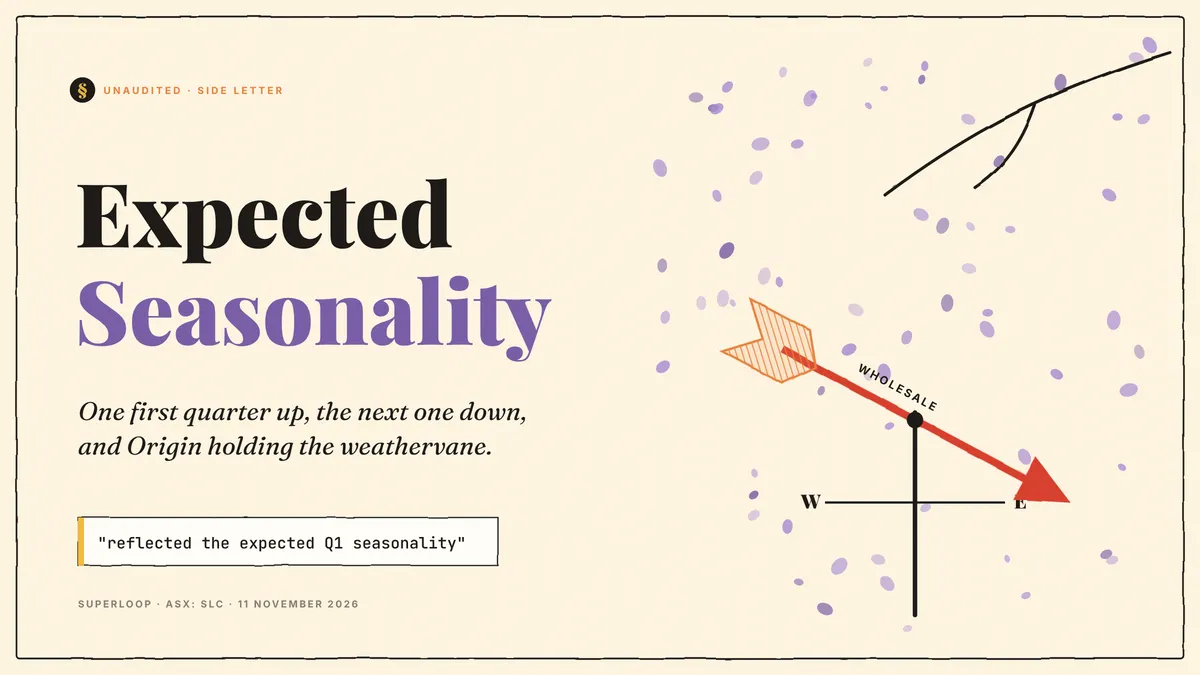

Every October the jacarandas come out across Sydney, and nobody lodges an announcement with the ASX about it. That is roughly what a season is.
On 10 November Superloop told the market its wholesale subscribers fell by 6,400 in the September quarter, which it put down to the expected seasonality of the first quarter, and by another 400 in October. In the first quarter of last year, by UBS's count at the time, wholesale grew by about 1,000.
The next morning Macquarie offered two other reasons, a cyber-security incident and Origin Energy promoting less. It then upgraded the stock at $2.47, five months after downgrading it at $3.48. The shares had closed 10 per cent lower the day before. A year earlier, between closes on 12 and 19 November, either side of that year's guidance, they fell 25 per cent.
The jacarandas come back on their own. Origin's promotions come back when Origin says so.
Expected
The trading update went out at 8.16am on Tuesday 10 November, together with a presentation to the UBS Australasia Conference, nine days before the annual general meeting. Last year Superloop gave its guidance at the annual general meeting itself.
Wholesale went from 317,200 subscribers at 30 June to 310,400 at 31 October. That was 6,400 lost in the September quarter and another 400 in October, which is not in the first quarter at all.
Superloop described the first quarter twice in the same announcement. Subscriber performance "reflected the expected Q1 seasonality". Growth was softer, "reflecting the seasonality typically seen in the first quarter".
A season is a thing that happens every year, so Side Letter checked the previous one.
This post is for subscribers only
Side Letter
Short items on what was agreed beside the deal. The announcement has the headline. We have the terms. Every side letter, filed in one place.
Until Withdrawn
Please Disregard If Already Paid

No Longer Connected
Expected Seasonality
Nine Or Ten
When Appropriate