Two Woolworths and an Anchorage
Anchorage has bought from a Woolworths before. Ask Dick Smith.
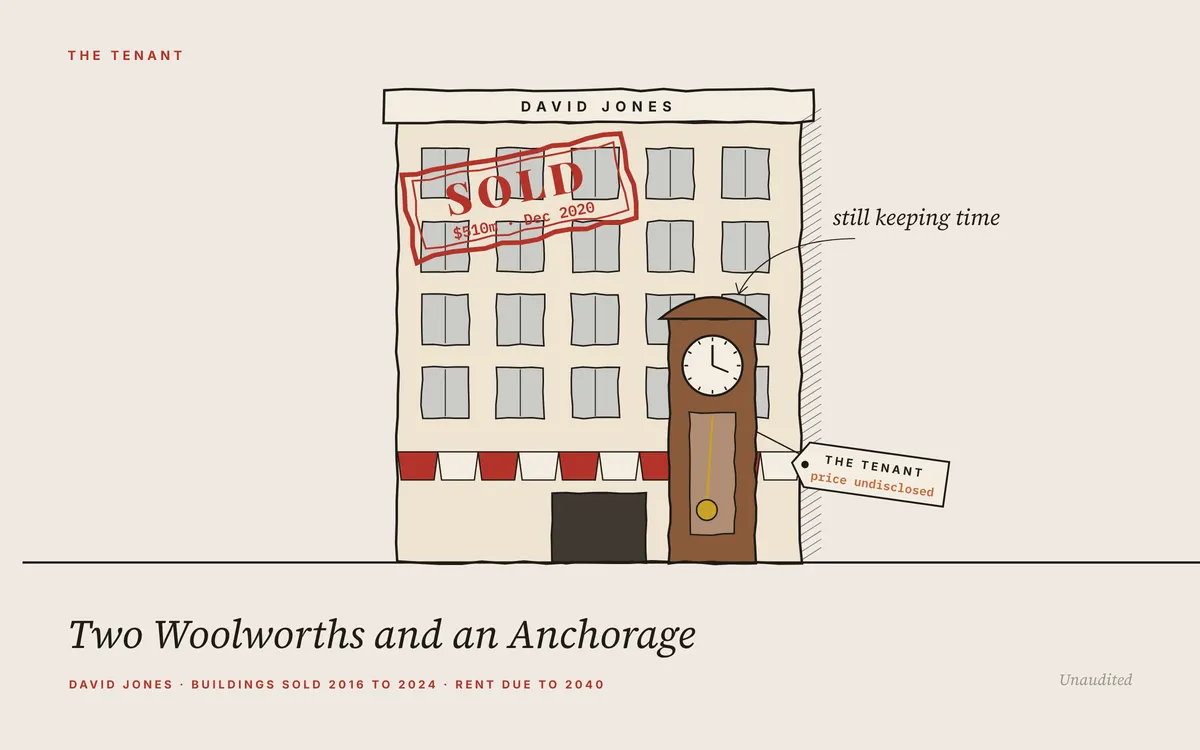

Every country clearing sale has one. The bloke who drives home with the grandfather clock, very pleased with the price, and learns over a beer that the farm was sold out from under it years ago and he now pays the neighbours rent on the wall it hangs on.
Woolworths Holdings paid $2.1 billion for David Jones in 2014. Between 2016 and 2024 it sold the four buildings that mattered for about $1.21 billion. In December 2022, with three gone and the fourth held back for later, Anchorage Capital Partners agreed to buy the shop, for a price reported at anywhere from $92.5 million to $150 million.
On 5 November 2026 the administrators arrived. They were McGrathNicol, who had also administered Dick Smith, another retailer Anchorage bought from a company called Woolworths.
The clock still keeps time. Westfield's rent was last paid up to 30 September.
Record-level
On the Monday after David Jones went into administration, the receivers, FTI Consulting, put out an update saying the department store had just enjoyed "record-level" sales over the weekend, in store and online.
It had taken 188 years, a South African owner, a Sydney buyout firm and a British distressed-debt lender, but somebody had at last worked out how to get Sydney into David Jones on a Saturday. You put up a sign suggesting it might not be there at Christmas.
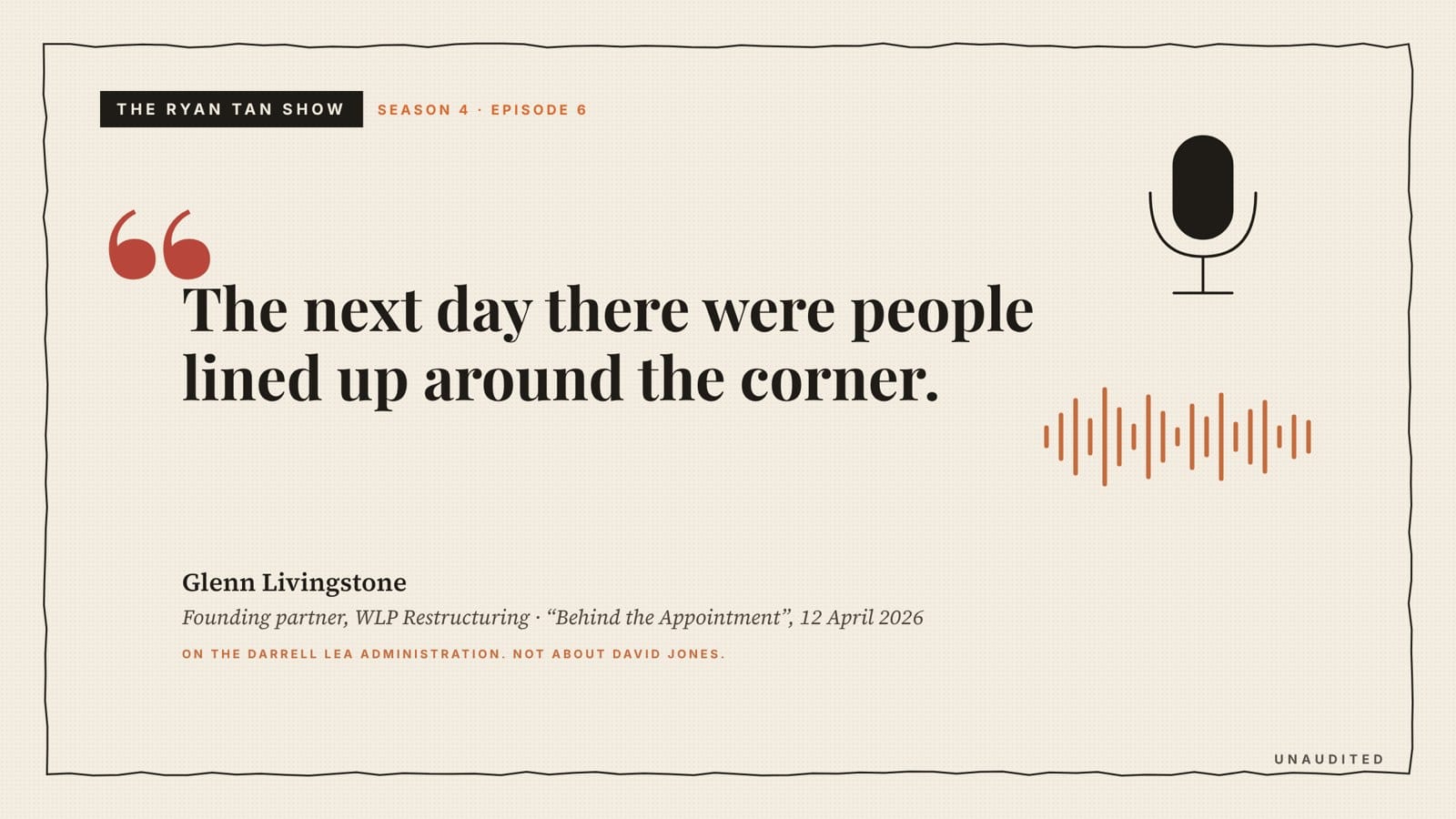
It has happened before. In April, on The Ryan Tan Show, the podcast hosted by Unaudited's author, the guest was Glenn Livingstone, a founding partner of WLP Restructuring and a registered liquidator with more than 1,000 formal appointments behind him. He recalled the administration of Darrell Lea, handled by his former partners at PPB Advisory. The day after the news broke, people were lined up around the corner for Rocky Road and chocolate bullets, and trading, he said, improved significantly.
Mr Livingstone was not talking about David Jones. He was talking about chocolate.
Nobody should be surprised by the turnout. Most of the country has a David Jones story, and this month a great many of them have been told on LinkedIn.
They tend to go like this. A child is driven into town after dinner and a bath, in pyjamas, to look at the Elizabeth Street windows, and falls asleep in the back seat on the way home. A five-year-old is taken through the food hall by childless family friends who treat her like a princess, and comes out with her first bottle of 4711 Eau de Cologne. Somebody is playing the grand piano. There are hams and exotic fruit stacked with the kind of precision usually reserved for military funerals.
Janet Saunders, 73, told AAP she had been shopping at the Bourke Street store since her mother first took her at about the age of ten.
A former university casual wrote this month about starting every shift by walking the floor, checking stock and learning which business shirts ran long in the sleeve. He once drove an hour, there and back, to a customer's house to cut off a security tag a colleague had forgotten, because the customer was flying out at dawn. Nobody charged for it. Nobody thought to.
On Reddit, women of a certain vintage remember the ladies' rooms, which came with a lounge and a dressing table, as though the store expected you to stay a while. Country customers remember the mail order catalogue. One man remembers playing Sonic on the Mega Drive in the electrical department, which is not strictly a retail strategy but tells you how long people used to hang around.
None of this is new. David Jones, a Welsh immigrant, founded the business in Sydney in 1838. The Elizabeth Street store opened in 1927. The first food hall opened at the George Street store in June 1936, which makes the David Jones food hall roughly as old as the Sydney Harbour Bridge and considerably better at selling oysters.
People can love a shop with their whole heart and still not go often enough to pay its rent.
The tidy version
The obituaries have run in the usual order. Weak trading, the cost of living, the landlords, the internet, and then, because it is always in there somewhere, private equity.
The tidy version goes like this. A buyout firm bought a national treasure, flogged the buildings, shut the food halls and left the carcass for the receivers.
It is a good story, and most of it happened. The trouble is who did it.
On the same Reddit thread, under a comment blaming venture capitalists for stripping the place, somebody replied with five words. "The South Africans stripped it first."
Most of the silver at David Jones was pawned before Anchorage turned up, by the people who sold it the shop.