
"Dear Vodafone, you suck." The chief executive said it first.
New Zealand's Vodafone was so bad it changed its name. Ours kept it.
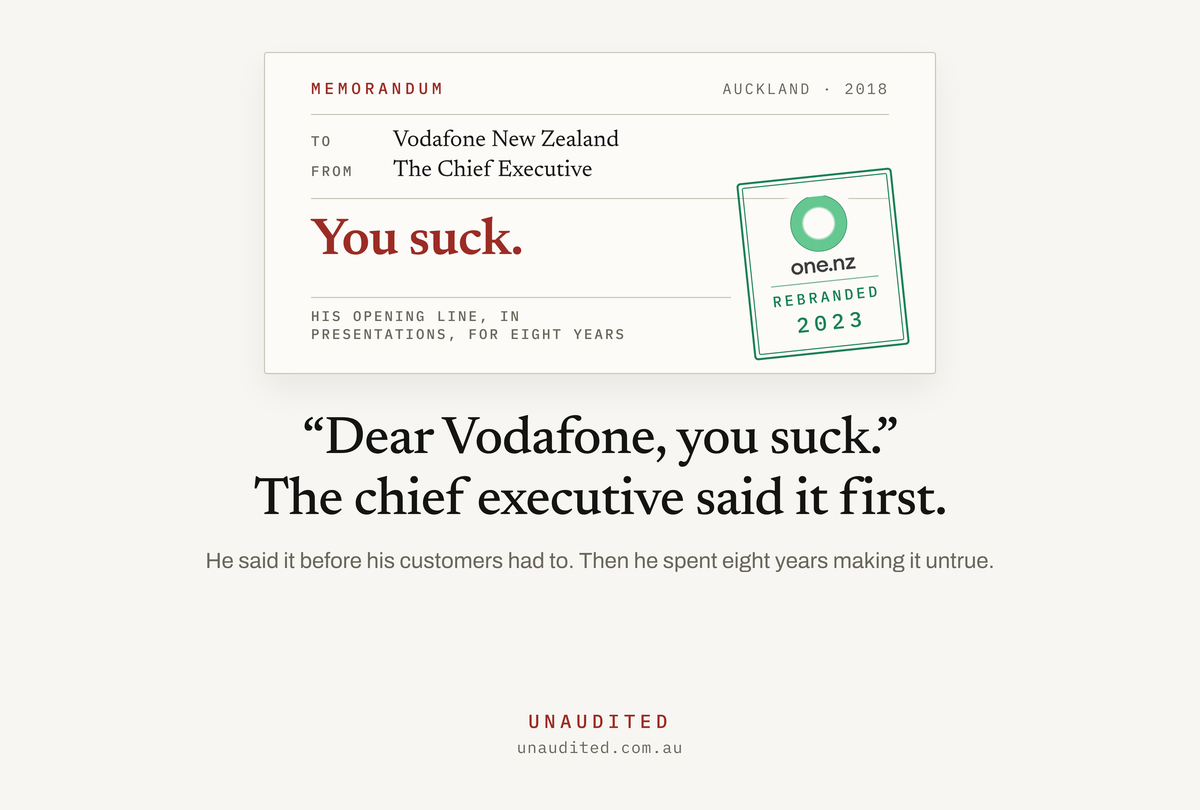
Jason Paris spent eight years fixing a telco. The sequence is the whole story.
Two telcos once carried the same brand, the same shareholder and the same formula written in the same head office in Europe. Both met the smartphone at the same moment and both were broken by it. One of them spent eight years fixing the network, then the service, then the price, and only then asked its country to reconsider the name. The other kept the name.
One Vodafone fixed the network and buried the brand. The other kept the one its own customers had already renamed, and is still flogging the horse. It does not own the horse. It licenses it, annually, from the head office in Europe. A Royale with cheese costs less.
Ask a chief executive what was wrong with the company he inherited and the answer is usually a paragraph, and usually about transformation.
Jason Paris took three words.
Network performance. Service performance. And value for money.
He left One New Zealand at the end of August after almost eight years, and took up the chief executive's job at Les Mills International on 6 October. What he set out in an hour on The Ryan Tan Show was not a strategy. It was an order of operations: the sequence in which a damaged telco has to be repaired.
It is worth saying at the outset that both halves of this story were once good. Vodafone launched in Australia in 1993 and bought BellSouth New Zealand in 1998, and for most of the two decades that followed its Australian and New Zealand operations were among the stronger performers in Vodafone's portfolio. Same brand, same shareholder, same formula. Both met the smartphone at the same moment, when data consumption stopped resembling anything either network had been dimensioned for, and both were damaged by it.
Seven years on, the two sets of accounts are not close.
The New Zealand business went from around NZ$463 million in earnings at acquisition to roughly NZ$600 million, an improvement of close to thirty per cent. It launched the first nationwide satellite text service in the world. Its owners have taken out close to what they put in and still hold half of it.