
Nobody Answered the Door
Swoop Holdings says it has migrated 100,000 services. It dated that figure the day before results, and the base it belongs to nine weeks earlier. Thirty-three thousand sit in the gap. Some now pay $10 a month to stay there.

They counted the wildebeest standing on the far bank.
Swoop Holdings has published one number from its crossing: a hundred thousand services migrated onto a new wholesale network, dated the day before results, and set against a base dated nine weeks earlier. It cannot be made into a percentage of anything, and it was never meant to be.
Thirty-three thousand services are unaccounted for in the gap between those two dates, and they are not treading water. The outgoing network's charges rose materially during the year, on Swoop's own account, and every straggler still standing in the shallows is billed by the head, which is a powerful argument against patience.
At forty-five days the company infers you no longer want the service and disconnects it, having first made reasonably certain you could not reach anybody to say otherwise.
A comparable operator lost eighteen per cent doing this properly, with sweeteners, on the account of an executive who was there.
Swoop offered a fifty-thousand-dollar prize pool. When that did not shift them, it began charging them ten dollars a month to stay where they are, while advising that it can no longer guarantee their service will work.
The migration will complete, in the way a census completes once you stop counting the houses where nobody answered the door.
The word doing the work
There is a term carrying an enormous quantity of unpaid freight in Swoop Holdings' full-year results, and the term is migrated.
It appears on slide four, in the company's proprietary magenta: 100k+ SIOs MIGRATED. It is offered as the operational achievement of the year, the proof that the transfer of Swoop and Moose Mobile customers from one wholesale network to another is proceeding to plan.
The footnote calls them active SIOs migrated as at 26 August. Active SIOs migrated is not a defined term, and Swoop does not define it.
It can be read two ways.
Either it counts services that were live when they were moved, a running tally since June, which is how migration trackers are ordinarily kept and which no subsequent departure ever reduces. Or it counts services presently alive on the new network, which would be a retention figure, and a genuinely useful one.
The company does not say which. It does not have to, because on either reading the number sits against a base dated nine weeks earlier and cannot be converted into a percentage of anything.
And there is a second undefined word sitting in the same three, which is active.
Active on a network is not the same thing as billing. Billing is not the same thing as paying. Paying is not the same thing as not disputing the bill. A service suspended at day thirty under the company's own migration policy remains, on most ordinary definitions, an active service. It simply does not work, and is not earning anything.
Somewhere inside the hundred thousand sits an unknown quantity of each. The footnote does not say which of them it counts, and the distinction is not academic.
But note what the first reading permits. A customer who activated her new SIM in July, discovered her plan now stops at 150Mbps, spent two hours on hold about it, and ported out in August is a completed migration. She sits inside the hundred thousand for good. She is a success and somebody else's customer at the same time, and no event after the fact removes her.
That is what a cumulative number is for.
The four columns
Anybody actually running a transfer of this size does not have a number. They have a spreadsheet, and it carries at least four columns.
One: the contracted base. How many services Swoop committed to move. Not necessarily the 135,000 waved about in June, and very probably a different figure sitting inside a contract nobody outside the two companies has read.
Two: successful migrations. Services that reached the new network and drew breath. The easiest of the four to produce and the least revealing of the four to know.
Three: port-outs. Customers who took the disruption as their cue.
Four, the only one that matters: services still active at thirty days, and again at ninety. Not activated. Not provisioned. Not "on the network." Billing, and paying, and not disputing it.
Which is where the footnote's second undefined word does its damage. Columns two and four can both be described, accurately and in English, as counts of active migrated services. They are not remotely the same number, and only one of them tells a shareholder anything.
This is not a novel framework. It is what any operator keeps internally, and no one modelling this tranche honestly treats 135,000 as one clean addition.
Swoop has published one of the four and declined to say which.
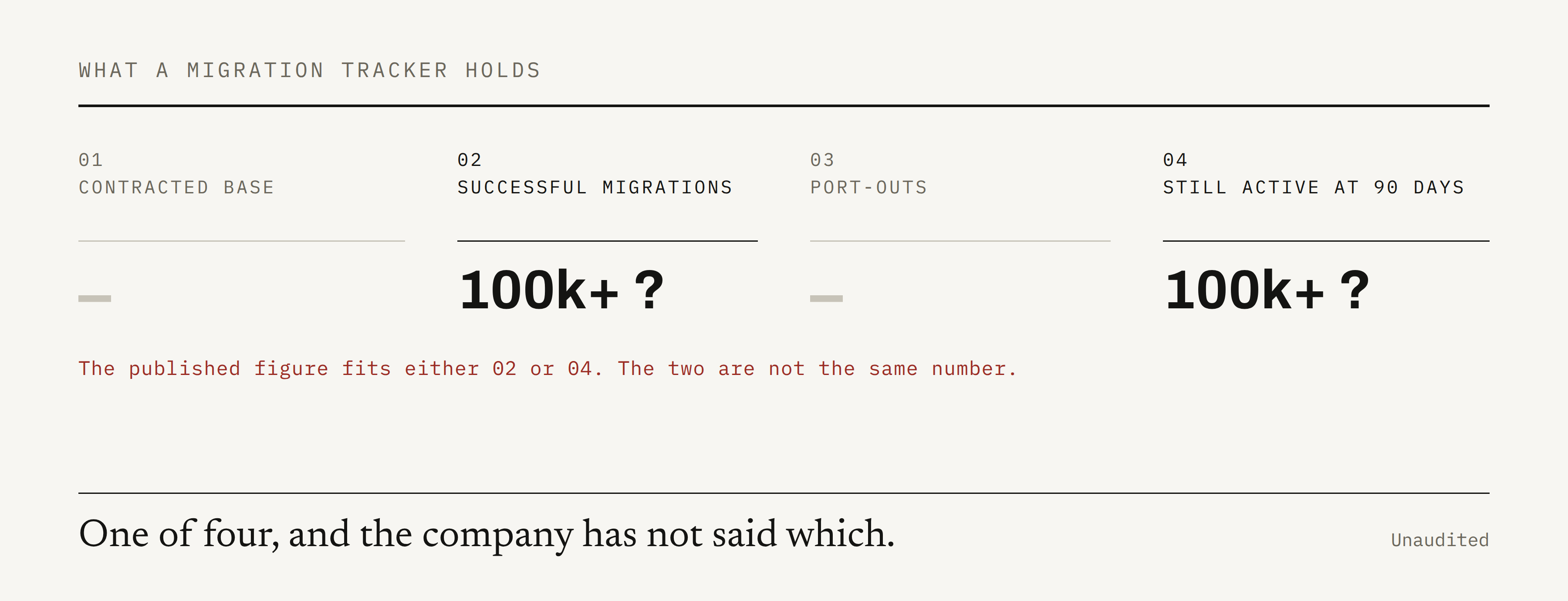
The footnote's wording sits most naturally on column two. It can be read onto column four by a reader in a forgiving mood. The distance between those two readings is the entire subject of this article, and the company has left it to the audience.
What is not in doubt is the fate of columns three and four. Neither carries a figure. The only base against which either could be measured is nine weeks stale.
What good looks like
The difficulty until now has been the absence of a control. Everybody agrees the migration has been messy. Nobody could say messy relative to what, because the industry does not publish migration attrition and has no earthly reason to begin.
There is one external benchmark available regardless, and one prior forecast by the author of this masthead. They land in the same postcode, which is either reassuring or a coincidence, and the reader is entitled to decide which.
The forecast first. It is the author's own, made in July, before the results pack existed: losses of some twenty thousand services, roughly fifteen per cent of the base, covering both active porting-out and the disengaged who let the forty-five day clock run into disconnection.
It is offered for exactly what it is worth, which is not much as evidence. A forecast reproduced by the person who made it corroborates nothing. Its only function here is to establish that the arithmetic below was not performed with hindsight.
The benchmark is the useful one.
Yomojo chief executive James Linton spent more than eighteen years at Exetel, which has completed the same exercise: a full mobile base moved from one wholesale host to another.
On Mr Linton's account, that migration retained approximately eighty-two per cent of the base. An eighteen per cent loss.
The provenance is worth stating up front rather than in a footnote. Mr Linton is a competitor, says so himself, and is presently running a switching campaign at the very customers this article is about. The figure is his recollection of a business he used to work for, not a number either company has filed. Discount it accordingly, and then note that it is the only figure anybody in the industry has been willing to put on the record, which is itself a finding of sorts.
And that was with a discounted month and a 100GB data bank pushed at the customers most likely to bolt, an inducement that landed, because most of that base sat on the cheapest plan available and a hundred gigabytes felt like a windfall.
Eighteen per cent, having spent money to hold them, by an operator who saw the attrition coming and provisioned for it.
Swoop's answer to the identical problem was to strip data banking out of the new plans, restore it some weeks later once enough people shouted, hand two free months to whichever customers reached the call centre and shouted hardest, and then, in the last days of July, announce a fifty-thousand-dollar prize draw: a car or thirty thousand in cash, five iPhones, twenty Visa cards. Update your SIM to WIN!, with the exclamation mark supplied by the company.
One operator budgets a retention allowance. The other runs a raffle.
Nobody is entered in a prize draw for accepting something they wanted. The competition exists because the company knows, at the level of its marketing budget, that a slice of its base will not activate unless bribed, and it has priced that reluctance at fifty thousand dollars.
Working it out
Take the most conservative denominator available. The June announcement said about 135,000. We will use Swoop's own year-end figure of approximately 133,000, because it is the smaller of the two and it appears in the results pack rather than a press release. And treat the "100k+" as a flat hundred thousand, since a floor is all the company has given us.
A hundred thousand of 133,000 is 75.2 per cent, which leaves approximately thirty-three thousand services, being 24.8 per cent of the base, sitting in the gap.
That sum assumes the numerator and the denominator describe the same population. The company has not confirmed that they do, and the nine weeks between them is a generous thing to wave away. It is nonetheless the arithmetic the slide invites, and the only arithmetic the slide permits.
What happened to the thirty-three thousand cannot be determined from anything Swoop has published. They are not necessarily lost. They are, at the absolute minimum, not accounted for, and the company is the only party in a position to account for them.
Now the clause that governs everything. Because a service that does not activate is disconnected at day forty-five, the eventual completion rate is a hard ceiling on the retention rate. Whatever share never crosses cannot be retained, by construction. Column four cannot exceed column two.
So ask what Swoop needs merely to match Exetel: an operator in the same country, moving off the same network, having paid its customers to stay, and still losing eighteen per cent of them.
It needs two things. Final completion of at least eighty-two per cent, which means at least nine thousand of the remaining thirty-three thousand must still activate. And then zero post-activation churn. Not one of the hundred and nine thousand may leave. Nobody may test the new network at home and dislike it. Nobody may finish waiting out the car raffle and go. Nobody may complete a port that the account-number problem has so far blocked.
The first is possible. The second is a condition no telco has met in any year, let alone this one.
What is left in that thirty-three thousand is not a random sample. It is the residue after ten weeks, which means it is disproportionately the awkward: the eSIM failures, the SIMs posted to addresses years out of date, the elderly customers, the households where somebody decided a month ago and simply hasn't done the paperwork.
From here the analysis leaves the filed figures and becomes a scenario. Two assumptions carry it, both of them this masthead's own, both arguable, and both set out plainly so that a reader who dislikes them can substitute his own and watch what happens.
Assumption one. Somewhere between a third and a half of the outstanding thirty-three thousand will eventually get across. Call it eleven to sixteen thousand, for eventual completion of 83 to 87 per cent, leaving seventeen to twenty-two thousand services that never cross at all.
Assumption two. Then subtract the ones who cross and leave anyway. Five to ten per cent of the activated base is restrained given what people are writing in public, and it is precisely the figure that would appear at thirty and ninety days if anybody published it. Another five and a half to eleven thousand services.
Scenario estimate, on those two assumptions: total losses of twenty-three to thirty-four thousand services, or seventeen to twenty-five per cent of the base. Final retention somewhere between seventy-five and eighty-three per cent, against Exetel's eighty-two.
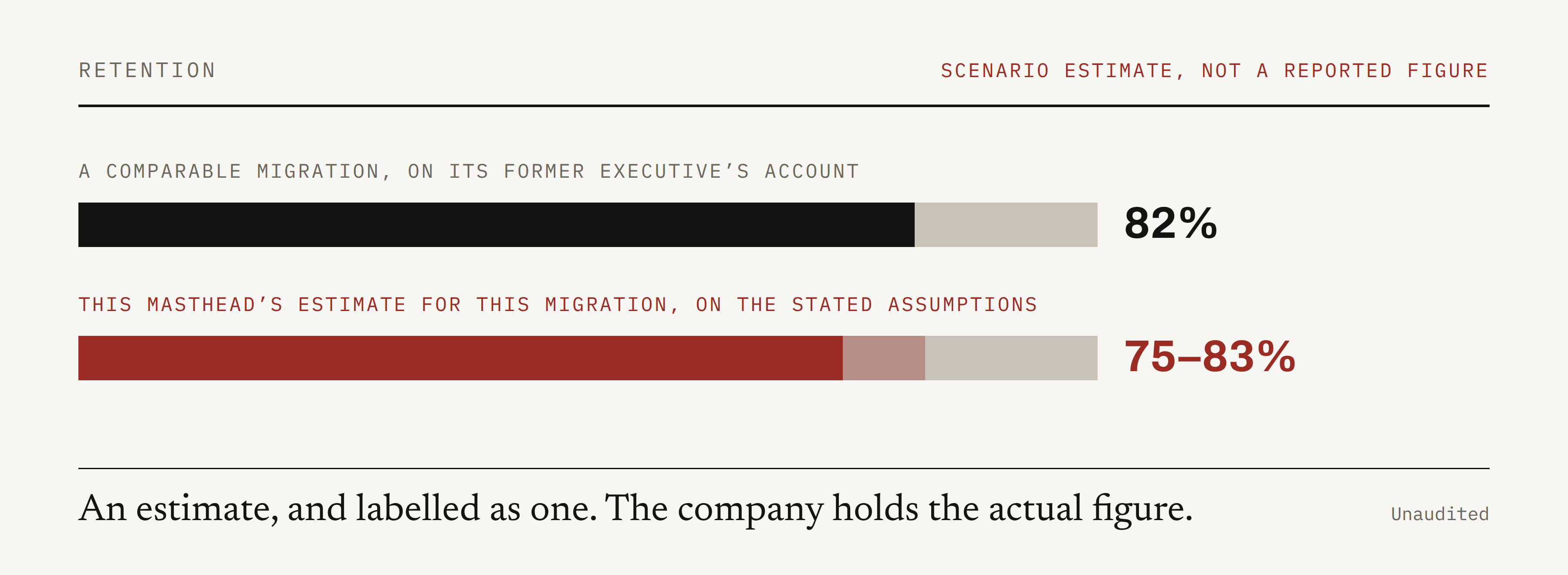
It is an estimate and it is labelled as one, which distinguishes it from the figure on slide four chiefly in the labelling. The company holds the actual numbers. It has published none of them.
And seventy-five per cent may yet prove generous, because it assumes the departures stop. They have not stopped. They have barely started, since most of this base has not reached ninety days.
The prize draw cohort is still sitting, waiting to see whether it wins a car before it leaves. The port-outs blocked by a changed account number are still queued. And the forty-five day clocks are running individually, on invitation emails that for a great many customers did not go out until late July.
The arithmetic that matters is the one at ninety days. Nobody has published it.
The two dates
Here is how it has been arranged, and the craftsmanship deserves acknowledgement before it gets the treatment.
The migration figure is dated 26 August. The day before results. Practically same-day.
The figure required to make any use of it, total mobile services in operation of approximately 133,000, sits three lines away on the same slide, dated 30 June.
A numerator from last Wednesday. A denominator from nine weeks earlier.
A company that can produce an active-services count dated the day before its results can produce a total-services count dated the day before its results.
It published one and not the other. Readers may form their own view about which of the two was going well.
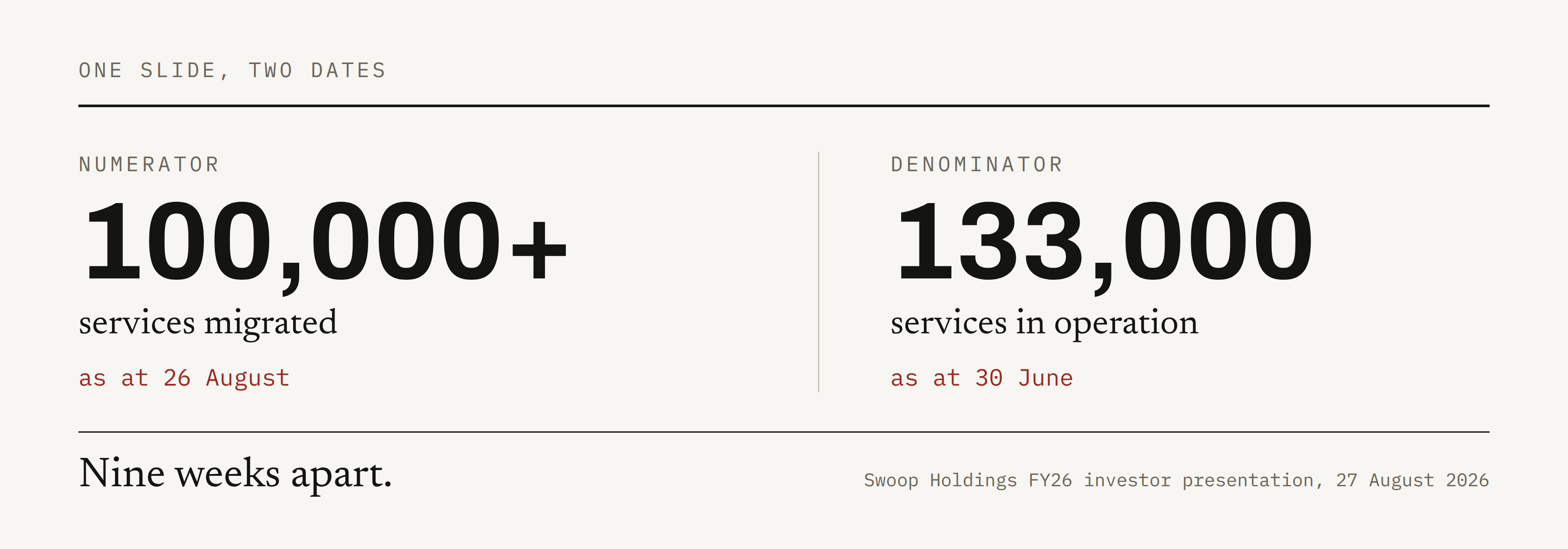
There is a further difficulty with the denominator, which is that it has previous form.
The company's own half-yearly mobile series, as presented to investors across the preceding two years, ran to roughly 131,000, then 128,000, then 127,000, then 127,000 at December 2025. Flat to gently declining across eighteen months, with a consistency that at least had the virtue of being believable.
In June the company described the base being moved as approximately 135,000. The FY26 pack puts services in operation at approximately 133,000.
So either the base sat flat for eighteen months and then added six to eight thousand in the one half-year nobody was counting it out loud, or the documents are measuring different things and have declined to mention it.
The second is the more likely, and the company has left the clue itself. The June announcement opens by describing mobile subscribers and closes, in the same breath, describing services in operation. These are not synonyms. A subscriber is a person with an account. A service in operation is a SIM with a number attached, and one person may hold several. One of those definitions makes a migration look larger. The other makes a customer base look larger. The company has used both, a few words apart, and defined neither.
This masthead does not suggest anybody has miscounted. It suggests only that a company which cannot hold a definition still for the length of a single sentence is poorly placed to be taken on trust about a fraction it declined to finish.
Why the call centre is in the accounts
For the mechanism one need not speculate. It is written down, in public, several hundred times, by the customers themselves.
The migration required a new SIM. Done properly the process is quick: begin it in the app, take the verification code by SMS on the old service, swap the card, and you are across inside a quarter of an hour. Plenty of people report exactly that.
The trouble is what happens when any part of it fails, because there is no self-service route around a failure and no obvious way back.
The commonest fault is the verification code, which arrives and is then rejected by the system that sent it, repeatedly, on every browser but occasionally not one.
Then the harder cases. Customers barred over a billing dispute and sent a reactivation code by SMS to the handset that had just been barred. Customers issued an eSIM whose physical SIM was cancelled in the process, who then discovered the handset did not support eSIM and were left with nothing. SIMs posted, with reminders, to people who had ported out a month earlier.
Each of those has exactly one exit, and it is a human being at Swoop.
The queue for a human being at Swoop has been running, on customers' own timings, between one and three hours by telephone, with live chat between forty minutes and four and a half hours, and a queue position that has been observed to travel backwards: thirteen minutes becoming thirty-one, third in line becoming twenty-fifth.
One customer waited two hours and forty-four minutes, and reports that the human being, once reached, fixed it in moments.
That last one is the damning one, because it establishes that the failure is not competence. It is headcount. Somebody decided how many people to put on the phones.
And somebody's decision is in the accounts. Employee benefit expense rose 3.5 per cent in FY26. Services in operation rose approximately 9 per cent. Across that same year the company changed wholesale carrier, deployed a new billing platform, launched eSIM and began moving its entire mobile base.
Slide twelve describes this as strong cost discipline.
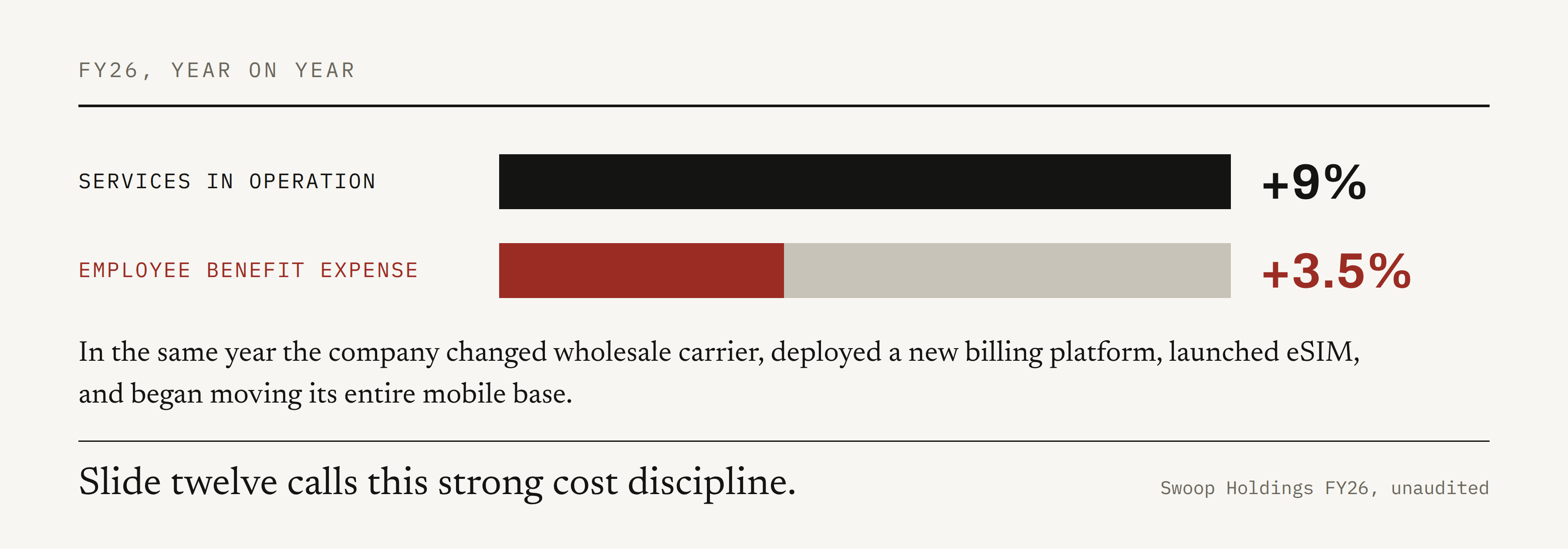
Strong cost discipline is what a four-and-a-half hour chat queue looks like from the twelfth floor.
There is one further detail, and it is an ordinary technical fact rather than a criticism of anybody. Outbound calls on MVNO plans on the incoming network terminate at two hours. It is a deliberate limit, it applies to wholesale and prepaid services, and it exists on many networks for sound reasons.
Swoop and Moose customers have been queuing for their provider's support line for longer than two hours.
Which produces a design so neat that no one could have intended it: a customer cannot complete a complaint about the migration without the migration intervening to stop him.
The clock
Which brings us to the disclosure that changes the arithmetic, and which appears not in the results pack but in Moose's own support documentation.
Customers have forty-five days from their invitation email to activate. At thirty days without action the service is suspended, with data, calls and texts restricted. At forty-five, in a sentence we would encourage the board to read aloud to itself, the company "will infer that you no longer want the service" and disconnects it. The number then generally goes into six months of quarantine.
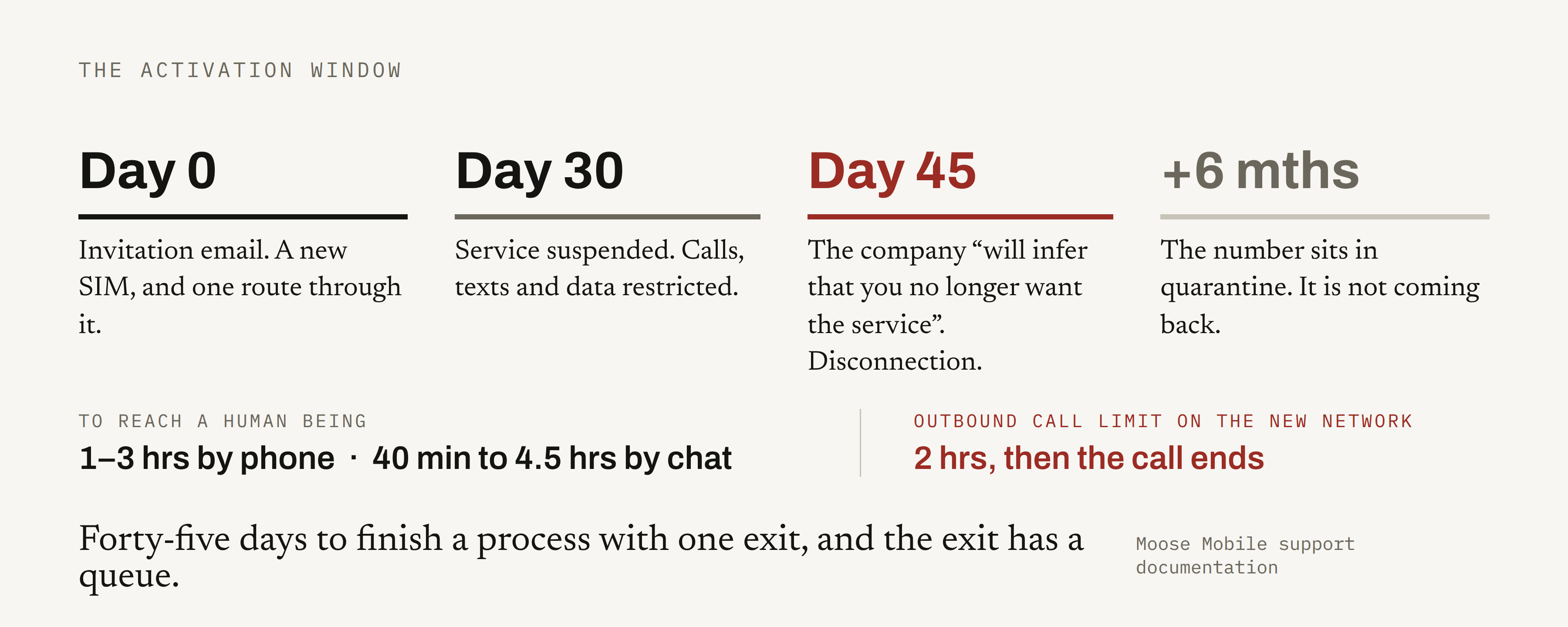
Read that against everything above.
A customer whose verification code will not work, who cannot reach the call centre because the queue outlasts the call itself, and who has no self-service path, will at day thirty lose their service and at day forty-five lose their number. Their intentions will be inferred from their failure to complete a process that the company's own headcount decisions made impossible to complete.
There is a commercial reason for the hurry, and it is disclosed elsewhere in the same results pack. Every straggler still sitting on the old network is billed to Swoop at charges the company has told the market rose significantly during the year, and which it chose not to pass on in full.
The relevant comparison is not against last year. It is against the arrangement the company is moving to, in a results pack that guides to a fifty per cent improvement in gross margin across the next three financial years.
So a service that has not migrated is not merely costing more than it used to. It is sitting on the expensive side of a gap the company has quantified for the market and undertaken to close, and every month it stays there is a month of the improvement not arriving.
The stragglers are not merely inconvenient. They are expensive, by the head, every month they remain in the shallows. A forty-five day deadline looks rather different once you know what the alternative costs.
And it moves the completion rate out of the operations report. A margin improvement delivered by a cheaper wholesale arrangement is, necessarily, a function of how many services are on it. Which is the figure nobody has published.
Which would be the end of it, except that the deadline has since been quietly replaced by something considerably more interesting.
Ten dollars a head
The company's own migration FAQ now answers the question of what happens to a customer who does not activate. It is worth reading in full, because every sentence of it is load-bearing.
If you don't update before the 1st October, we'll continue to support your service for as long as we're able to. However, as only a small number of customers remain on our older systems, the cost of maintaining them has increased.
To help cover these ongoing costs, a $10/mth Legacy Network & Platform Fee will be applied from the 1st October. We're committed to helping customers transition smoothly, but we can't guarantee service stability beyond this date.
Three things fall out of that, and they fall in ascending order of consequence.
The clock did not run. The forty-five day policy said a customer who failed to act would be presumed to want no service and disconnected. That was August. By October the same customers are not disconnected; they are being invoiced. Whatever the intention was in August, the stragglers did not resolve themselves into a tidy completion figure. They persisted, in numbers sufficient to justify building a new line on the bill.
The phrase is doing two jobs at once. Note it, because it now makes its third appearance in this saga: a small number of customers.
The sentence it sits in is, to be fair, economically coherent. A legacy platform costs roughly what it costs whether four thousand services sit on it or forty thousand. Spread that over a shrinking cohort and the cost per remaining customer rises. The company's logic holds and this masthead will not pretend otherwise.
What is worth noticing is the work the same three words are asked to do in two different documents.
In the results pack, a small number is a reassurance. It tells shareholders the disruption was contained.
In the migration FAQ, it is a justification. It explains why a new charge is necessary.
The company would like the cohort to be small when investors ask about it and expensive when customers do. Both can be true at once. Neither has been quantified.
What the fee does establish is something the company has not otherwise conceded. Somebody inside Swoop considered this cohort material enough to create a new monthly charge for it, notify a base about it, and put it through a billing run. That is not a headcount. It is evidence that a headcount exists, and that somebody has already done the sums on it.
It is the raffle in a different suit. The raffle was a carrot for the customers who could be persuaded. This is a charge for the ones who could not.
And then the last clause. We can't guarantee service stability beyond this date.
That is a retailer telling its own paying customers that their telephone service may stop working, and declining to say when. Read plainly, it is a statement about an arrangement the company does not control, published to the people who will find out first.
There is a fourth observation, and it concerns who is actually being charged.
The fee lands on the cohort that did not activate. That cohort is, on the evidence set out above, disproportionately the people whose verification codes failed, whose SIMs went to an old address, whose handsets could not take an eSIM, and who then spent between one and four and a half hours failing to reach anybody about it.
The company could not answer their calls. It has had no difficulty finding them for the invoice.
A price rise applied to the most disengaged and least well-served segment of a base, in the middle of a migration that segment has already declined to complete, is not a retention instrument. It is a departure lounge with a cover charge.
Column three is worse than it looks, in both directions
Two things are happening to the port-out number, and they pull against each other.
The first suppresses it. Porting out requires the account number, because these are postpaid services. The account number changed on migration. Customers read the old number off an old invoice, where the invoice was still there, several reporting the billing history vanishing from the portal, supplied it, and the port failed. The receiving carrier told them, accurately and uselessly, that the details were incorrect. Two and three failed attempts before anybody worked out that the number Swoop had given them was no longer the number Swoop was using.
One customer resolved it by posting a complaint on ProductReview and being contacted within half an hour, having previously spent close to four hours on hold and lost a chat session on top.
Which is the retail equivalent of keeping eight tills open and nobody on the returns desk. The complaint that is visible gets answered in half an hour. The complaint that is merely urgent waits four.
We make no allegation that any of this was designed. Migrations produce data problems and this looks like one. But the consequence is that some proportion of the customers who have decided to leave have not yet managed to leave. For now, they count as retained.
The second thing is worse for Swoop, and it is only beginning. A cohort is sitting still on purpose. Some are waiting out the prize draw, on the entirely rational basis that a shot at a car is worth another month of a service they intend to abandon. Others are testing the new network before deciding, and reporting the results to one another in public as they go.
They are not churn statistics yet. Some of them will be.
What they said by accident
Two things escaped the results pack, and both are retention forecasts wearing other clothes.
The first, under "Revenue and margin in focus," records that the incumbent network supplier significantly increased mobile charges during FY26, and that the increases were not fully passed on in order to hold the base ahead of the transition. Gross margin fell from 34 per cent to 27 per cent, and gross profit went backwards, from $32.3 million to $31.7 million, on revenue that rose $20.7 million.
Swoop spent a full year's margin holding the base together long enough to hand it over, and appears to have lost a quarter of it anyway.
The second is quieter. In the investing cash flows sits a line that did not exist a year ago: payments for security deposits, $3,496,000. Slide thirteen says the deposits were required to ensure the success of the telco transition and operating leases.
Required by whom, it does not say. The split between the transition and the leases is not disclosed, and the counterparty is not named. Deposits of this character are ordinarily posted by the incoming customer to the incoming carrier, but we are not going to assert what the company has declined to state.
So we will ask instead. Who holds the $3,496,000, on what terms, and when is it released?
Because if a wholesale host has taken cash collateral from a customer, that is a credit assessment made by people with full sight of the numbers, and it tells you rather more about the expected life of this arrangement than any slide does.
Note 20
There is a second unnamed counterparty in these accounts, and unlike the first it arrives with a figure attached.
Note 20 records up-front payments received totalling $3,752,579, to be recognised through the profit and loss account across the next three financial years. Non-current contract liabilities stand at $2,567,554, against nil a year earlier. Straight-lined, that is something in the order of $1.25 million a year.
Three financial years. FY27, FY28 and FY29.
Which are the same three financial years as the margin guidance above, and the same three years as the term of the wholesale agreement.
The payer is not named.
Now the part that makes this a question rather than an accusation.
A contract liability, under the accounting standard, is an obligation to transfer goods or services to a customer. It arises when somebody who buys from you has paid before you have delivered.
Which sits awkwardly with the obvious reading. A large up-front payment landing in the same year a wholesale agreement is signed invites the assumption that it came from the incoming network. But Swoop buys from that network. In that relationship Swoop is the customer and the network is the supplier, and money running from a supplier to its customer is a rebate. A rebate is conventionally deferred against cost of sales. It is not a contract liability.
So the line is one of three things.
It is money from a genuine customer, prepaying three years of something.
Or it is money from the incoming network in a different capacity, as a customer of Swoop's, buying something in the other direction.
Or it is a supplier incentive sitting in a line that does not describe it.
Each of those is a materially different account of this company's year. Shareholders have been told which one by nobody.
If it is the third, the structure matters, because incentives of that kind are conventionally paid up front with a clawback attached: if a service ports out or is cancelled inside an agreed window, the retailer repays the portion attributable to it.
Which would mean two things, and both run against the direction of the slide.
The money is banked at migration, not at retention. Cash received for a base the company has not yet kept.
And churn would run backwards. Every departure inside the clawback window is not merely a lost customer and a lost margin. It is a repayment. The seventeen to twenty-five per cent of the base estimated above stops being a revenue problem and becomes a cash liability, falling due at a time not of the company's choosing.
There is a final observation, offered with the disclaimer attached before the sentence rather than after it. This masthead makes no suggestion whatever that any figure in these accounts was selected by reference to a commercial arrangement.
It observes only this. If an incentive anywhere in this transaction is struck per service migrated, then 100k+ SIOs MIGRATED is not purely an operational metric. It is a quantity with a price beside it. And a cumulative count that includes every service ever moved, which no subsequent departure reduces, is the version of that quantity a recipient would prefer.
The number has two possible uses. The company has explained neither.
Two figures that do not cancel
They are close enough in size that a hurried reader will net them off, and they do not net.
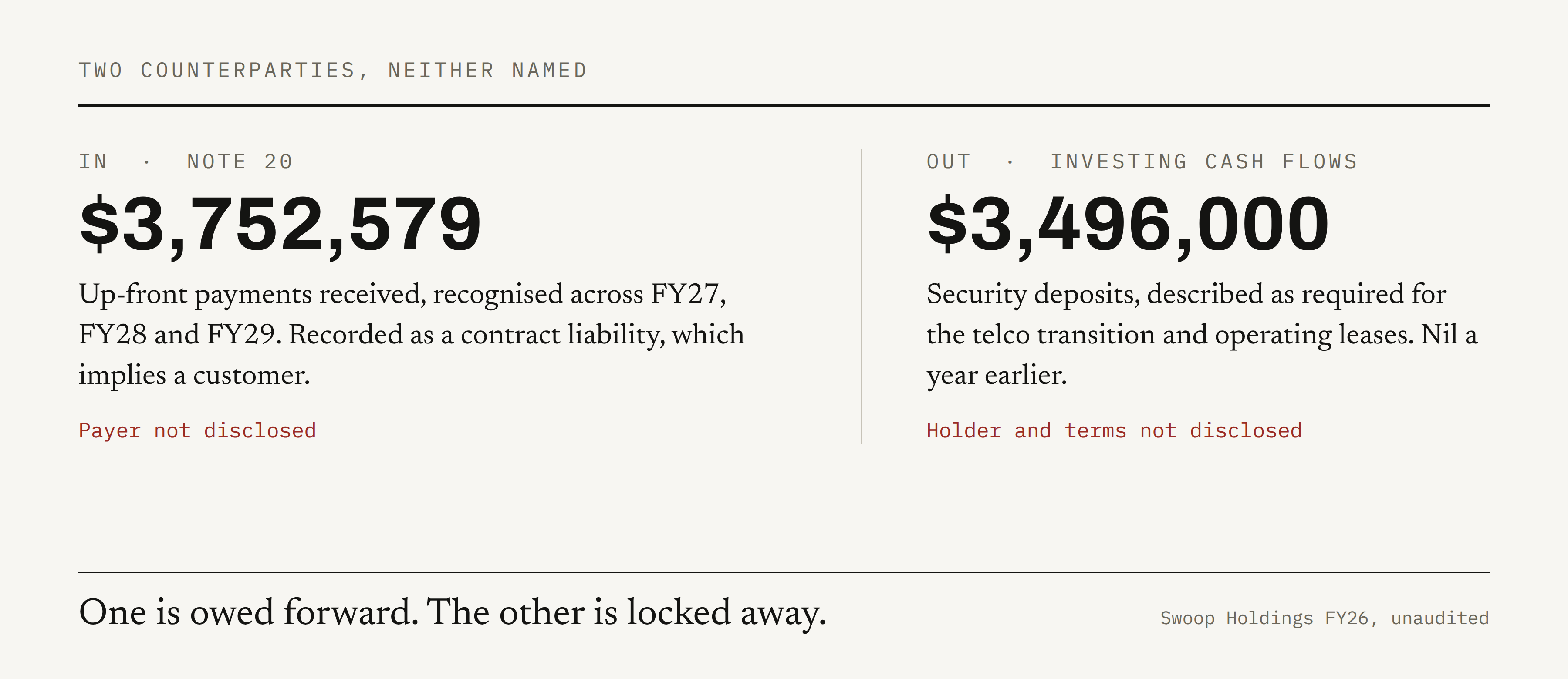
$3,752,579 in, deferred across three years, payer unnamed.
$3,496,000 out, posted as security deposits for the transition and for operating leases, holder unnamed, split between the two purposes undisclosed.
The first is cash the company has already received and must now discharge, over three years, in services delivered or margin foregone. It is an obligation dressed as a receipt.
The second is cash the company had to hand over to get the transition done at all. It sits on the balance sheet as an asset, returnable at some future date on terms nobody has published.
One is money owed forward. The other is money locked away.
Neither is money available.
The platform that failed is an asset
While we are in the cash flows: total capital expenditure of $15.4 million includes $9.3 million of capitalised technology-platform development.
Capitalised. Not expensed. Sitting on the balance sheet as an asset with a future, amortising gently over the years to come.
That is the billing platform, the provisioning workflow and the customer portal. Which is to say it is the verification codes that do not work, the two-factor that locks people out of their own billing page, the activation flow with no self-service fallback, and the account number that changed without telling anybody.
Slide nine calls it zero-touch and puts the words "Proven 5K+ orders per day" in a coloured box.
The $9.3 million now sits on the balance sheet as an asset, to be amortised across its useful life and subject to the ordinary impairment requirements.
Which makes the customer experience set out above rather more than an operating irritation. It is the observable performance of a platform to which this company has assigned substantial future economic value, in a set of accounts nobody has signed yet.
Worth noting in passing: the allowance for expected credit losses very nearly doubled, to $1,441,082, and the bad and doubtful debt expense rose 155 per cent to $684,873. A larger base accounts for some of that. The composition of the rest is not disclosed and this masthead will not invent it. We observe only that the year in question is also the year in which customers began reporting, publicly and in volume, charges taken after cancellation, after porting, and at rates other than the ones printed on their plans, with some going to their banks and some to the Ombudsman. Whether any of that has found its way into the provision is a question for the notes, which decline to take it.
The other cumulative number
To slide seven, given over entirely to customer satisfaction, where the same instinct turns up on a smaller scale.
It reports 4.9 out of five across more than 5,600 ProductReview entries, 98 per cent of reviewers recommending, and, a curious thing to boast about in the circumstances, a review volume significantly exceeding that of other telcos with comparable ratings.
Start with the fact that the 4.9 belongs to the Swoop listing. Both brands migrated, but Moose carried the volume and Moose carried the damage, and Moose is nowhere on slide seven. Three customer testimonials appear elsewhere in the deck. All three concern Swoop. A results pack published in the middle of the transfer contains a customer satisfaction slide with the affected brand taken out of it.
Then the arithmetic. A rating carried on five and a half thousand reviews is a very difficult thing to shift. Years of contented customers sit underneath it like sandbags, and a few hundred furious ones arriving in July land on top of the pile without moving it much. Moose's own ProductReview score has eased to about 4.6, which for a listing that size is a real fall, and still tells you almost nothing about what is happening now.
So look somewhere with fewer sandbags. Moose's Google rating is 3.8 across roughly 670 reviews, and what is arriving there this week, and last week, and the week before, is close to uniformly one star, overwhelmingly from customers of five, six and eight years' standing, a striking number of whom open by saying the service used to be excellent.
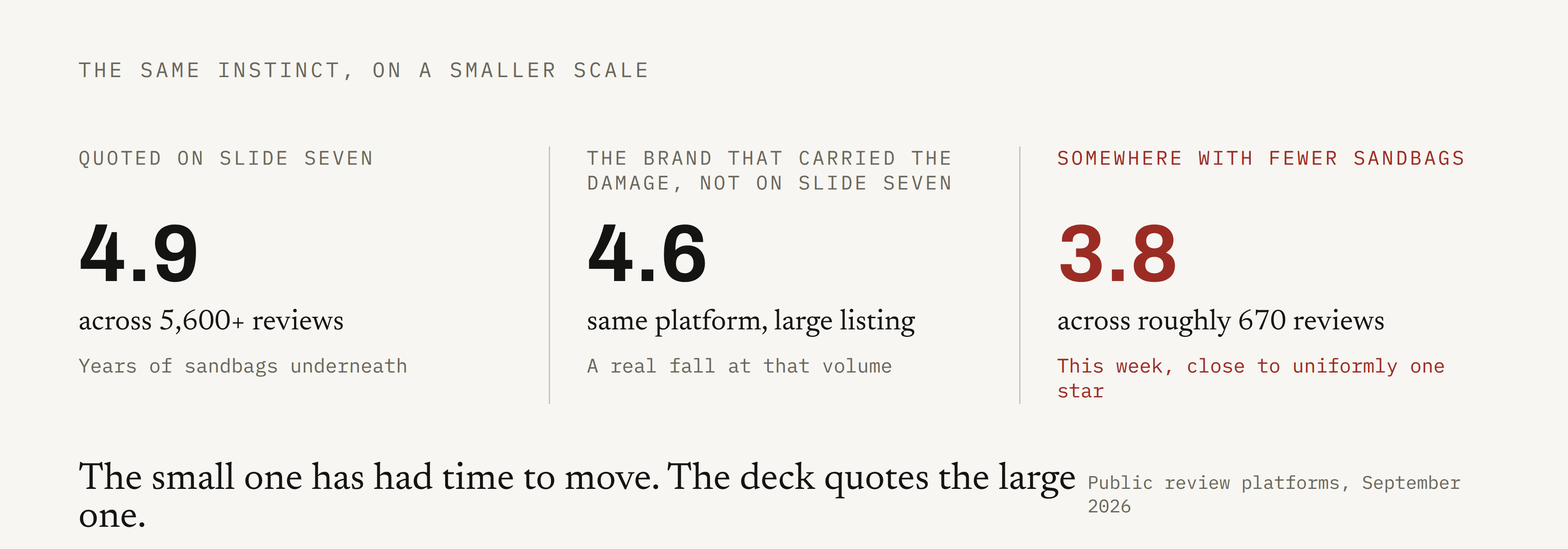
None of them contradicts the others. The small one has simply had time to move and the large one has not.
The deck quotes the large one.
And then the place with no sandbags at all.
Moose is currently paying to advertise on Instagram. The creative is cheerful. The comments underneath it are not, and they are not from passers-by who wandered in to complain: they are from existing customers, gathering under a paid advertisement for the product they already own, to advise strangers against buying it.
There is no metric in that and this masthead will not invent one. There is only the arrangement, which is that the company is paying, by the impression, to deliver its detractors an audience.
All of which is slide four again in a different suit. Count the ones who arrived, never the ones who stayed. Publish the total since June, never the total this morning. Once is a presentational preference. Twice, in the same document, on the same morning, is a habit.
Questions for the company secretary
What was total mobile services in operation at 26 August 2026? You published the migration figure to that date. Publish the base to the same date. Same system, same report, same morning.
What does "active" mean in the footnote to slide four? Provisioned, billing, paying, or none of those in arrears? Columns two and four of any migration tracker can both be described as active migrated services, and they are not the same number.
How many services were still active and paying at thirty days after activation, and at ninety?
How many services have been suspended at day thirty, and how many disconnected at day forty-five, under the policy that infers a customer no longer wants the service? And how many were instead moved onto the Legacy Network & Platform Fee?
How many customers is the $10 monthly fee expected to apply to? You have described them as a small number and priced them at the same time. One of those two figures is available to you.
What is the basis for the statement that service stability cannot be guaranteed beyond 1 October, and what notice will affected customers receive if it is not?
Who holds the $3,496,000 of security deposits, on what terms, and when are they released?
Who paid the $3,752,579 recorded at Note 20, and for what? The amount is deferred across the same three financial years as the margin guidance and the wholesale term. It is recorded as a contract liability, which implies a customer. Name the customer.
Does the wholesale arrangement carry a migration incentive? If so, was it received up front, is it struck per service, does it carry a clawback, and over what window? Shareholders are entitled to know whether the number on slide four is an operational metric, a billing quantity, or both.
Answer them and "a small number of customers" resolves itself in a sentence.
Decline, and shareholders may draw their own conclusions about why column two was published while columns three and four were dated out of existence.
Right of Reply
Swoop Holdings Limited, Moose Mobile, and any director, officer or individual who considers themselves referenced in this article are invited to correct, clarify or add context to anything set out above, including total mobile services in operation as at 26 August 2026, the number of services suspended at day thirty and disconnected at day forty-five, and the holder and terms of the $3,496,000 in security deposits.
Responses will be published in full and without editorial amendment, subject only to law and the privacy of third parties.
This right of reply remains open indefinitely, which is rather longer than the wait time currently advertised on the migration helpline.
Sources and method
Sources. Swoop Holdings Limited's Appendix 4E, Preliminary Final Report and investor presentation of 27 August 2026 and its ASX announcement of 16 June 2026, all unaudited at the date of publication; the company's earlier half-yearly investor presentations; Moose Mobile's own published support documentation, migration information and promotional terms; publicly posted discussion on consumer forums and review platforms; publicly available consumer review and market data; and information provided on the record by the chief executive of Yomojo. No confidential, privileged or non-public information has been used.
The migration figure. 100k+ active SIOs migrated is reproduced as published. The company does not define the term. This article does not assert which of the available readings is correct, and every calculation performed on the figure is identified in the text as conditional on the reading adopted.
The survival estimate is an estimate. The figures for eventual completion, retention and total service losses are this masthead's own arithmetic on stated assumptions. They are not a finding, and they are not a company disclosure. The denominator is Swoop's own reported approximately 133,000 mobile services at 30 June 2026, being the more conservative of the two figures it has published. The assumptions as to how many outstanding services will eventually activate, and as to post-activation churn, are the author's judgement. They are set out in the body rather than buried here, so that a reader who disputes them can substitute his own.
The half-yearly series. Mobile services figures attributed to earlier company presentations are drawn from those presentations as published. Where the June 2026 announcement and the FY26 results pack use different terms, both are reproduced as they appear, and no assertion is made that either is inaccurate.
The security deposits. The $3,496,000 is disclosed in Swoop's own cash flow statement and described in its own investor presentation as required in connection with the telco transition and operating leases. The counterparty, the split between those purposes and the terms of release are not disclosed. This masthead does not assert who holds those funds. The posting of security by a wholesale customer is an ordinary and lawful commercial arrangement.
The forty-five day policy and the Legacy Network & Platform Fee. The activation deadline, suspension at thirty days, disconnection at forty-five days and subsequent quarantine, and the text of the migration FAQ concerning the $10 monthly fee from 1 October, are drawn from Moose Mobile's own published support documentation and quoted as published. Deadlines and legacy-platform charges are ordinary features of network migrations, and a retailer is entitled to recover costs it incurs. What is drawn from them here is opinion.
Note 20. The $3,752,579 in up-front payments received, the non-current contract liability of $2,567,554, the prior-year comparative and the three-year recognition period are reproduced as filed. The counterparty is not disclosed. The three readings canvassed are offered as alternatives rather than conclusions. The commentary on how supplier rebates are conventionally treated relative to contract liabilities is general commentary on the accounting standard, and is expressly not an assertion that this item is misclassified or that these accounts are improperly prepared. They are unaudited at the date of publication.
Migration incentives. The existence, size, structure and terms of any migration incentive in the wholesale arrangement are not disclosed by either party. The description of how such incentives are conventionally structured reflects ordinary and lawful commercial practice in the sector, and is not a statement about this arrangement. Every consequence drawn from it is conditional and identified as such in the text.
The outgoing supplier's charges. Swoop's own disclosure records that its incumbent mobile network supplier significantly increased charges during FY26 and that the increases were not fully passed on. The disclosure does not state the reason for the increase or its timing, and this article asserts neither.
Customer reports are the statements of their authors, published by them in public forums, and are relied upon as evidence of the volume and character of public complaint rather than as findings of fact about any individual's circumstances. None has been independently verified. Those who post are self-selecting and are not a representative sample of anything. That includes the reports of altered account numbers and failed port requests, where the article expressly contemplates inadvertent consequence of a platform migration as an available explanation.
The Exetel benchmark. Statements attributed to James Linton, chief executive of Yomojo, were provided by him on the record. Mr Linton is a competitor and has run a switching campaign directed at Moose customers, which he has disclosed publicly and which is disclosed in the body of this article. The retention figure is his account of a migration undertaken by a business he was formerly associated with, and has not been independently verified. No payment or consideration passed in either direction.
Disclosure
This article is independent commentary, opinion and analysis on a matter of public interest, based on the sources identified above. Estimates are identified as estimates and depend on the stated assumptions. Characterisations of strategy, sequence, incentives and corporate approach are the author's honest opinion, formed on reasonable grounds, and are published in reliance on the protections afforded to honest opinion, fair comment and publication in the public interest under the Defamation Act 2005 (NSW) and its state equivalents.
No allegation is made, and none should be read, that Swoop Holdings Limited, Moose Mobile, any related entity or any individual has engaged in misleading conduct or breached any law, regulation, code or standard. All retain the presumption of lawful conduct unless a competent authority determines otherwise.
Nothing here is financial, investment or legal advice, or a recommendation to buy, hold or sell any security. Swoop, Moose Mobile, Yomojo, Exetel and ProductReview.com.au are trademarks of their respective owners, used for identification and commentary only.
The author holds no interest in Swoop Holdings Limited, Yomojo or any other entity named in this article, and received no payment or consideration from any party in connection with it.