
Cost of Sales
Australia's fastest-growing accounting firm lost $38.9 million in twenty-two months and never once made a gross profit. The buyer paid a dollar upfront. The staff got around fifteen cents. The clients got nothing.
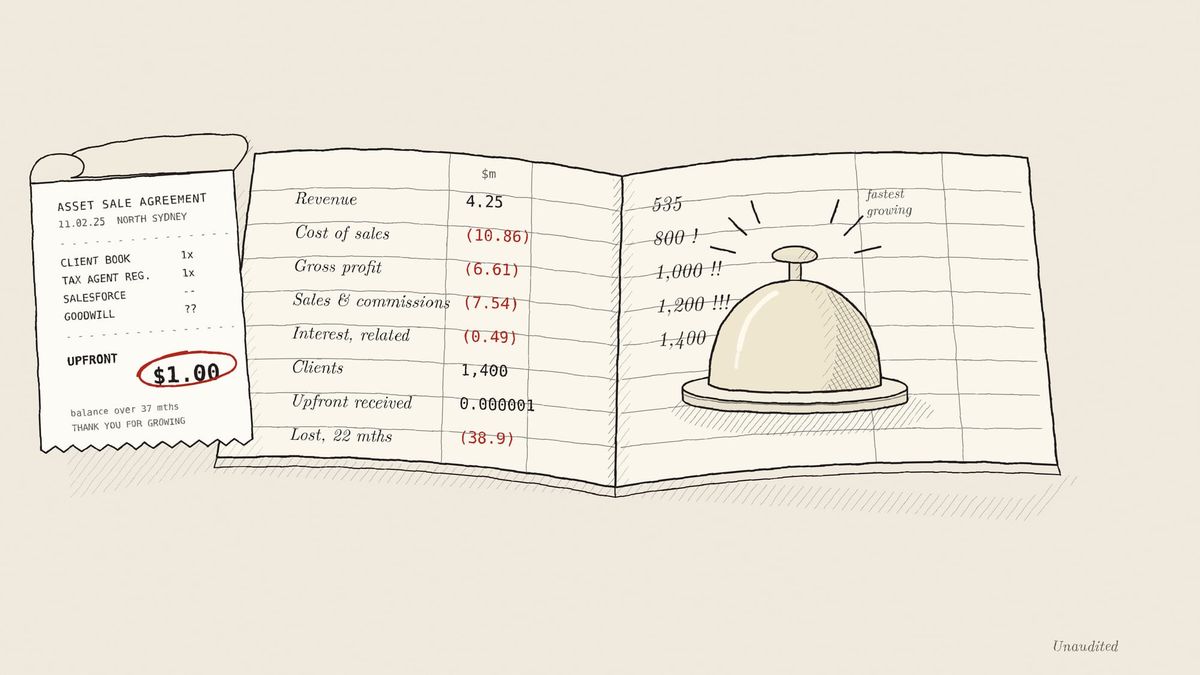
Australia's fastest-growing accounting firm never made a gross profit. Not once. Then it was sold for a dollar.
Accountants are not a thrilling people. That is the point of them.
The whole profession rests on being the least fun person at the barbecue. The one who reads the terms. The one who prices the risk. The one who looks at a new client's shoebox of receipts, notes that some of them predate the Keating government, and politely suggests they try someone else. Nobody has ever described their accountant as a disruptor. It would be taken as an insult, and rightly so.
So when a firm opened on Level 5 of 100 Walker Street, North Sydney in April 2023 promising to disrupt accounting, the correct response was the accountant's response. A long silence. Then a request to see the numbers.
Nobody asked. Or if they did, nobody was listening.
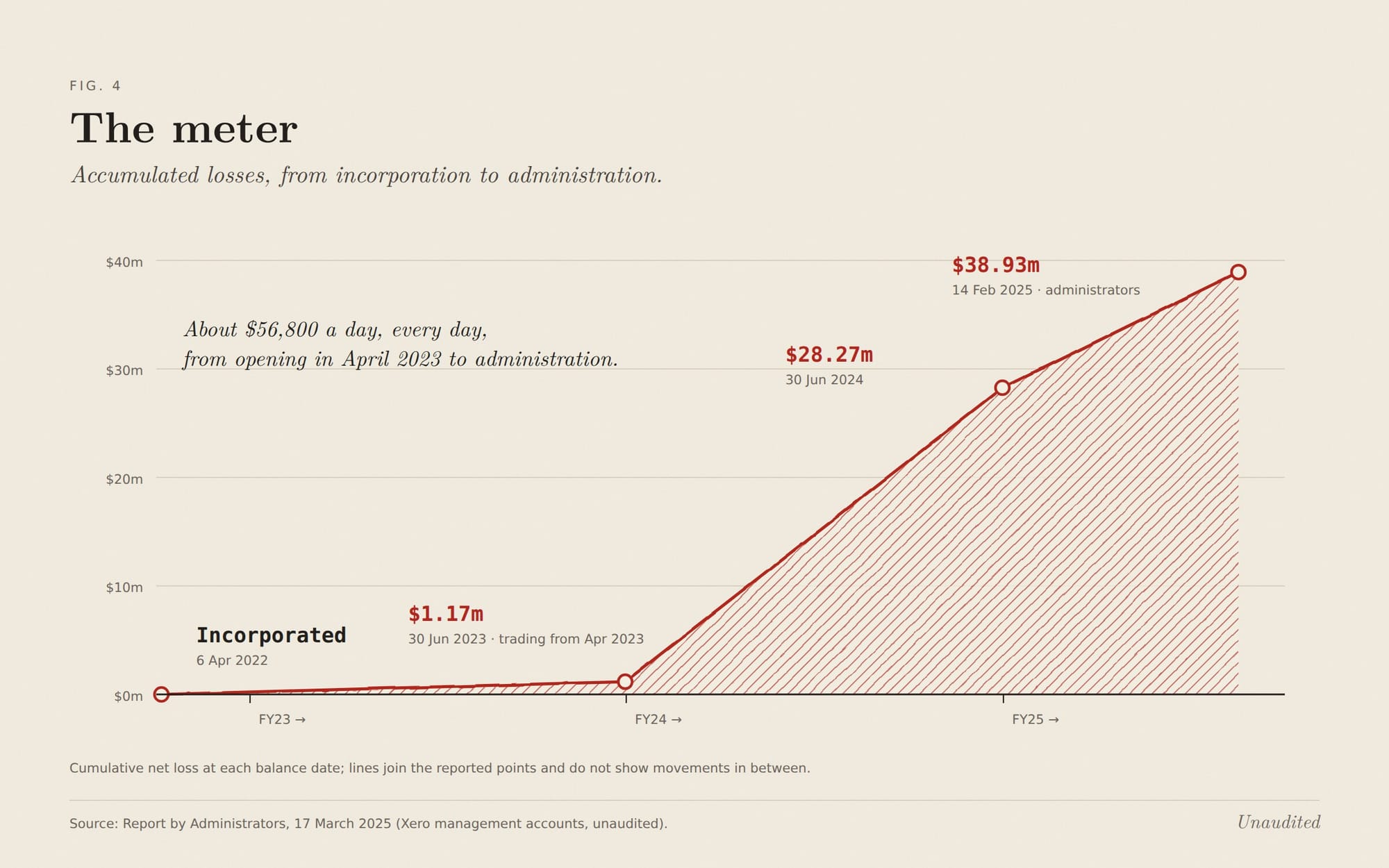
Twenty-two months later, the firm was in administration. A month after that, liquidation. In between, it grew faster than any accounting practice in the country, hired a sales floor that would not have looked out of place in a real estate franchise, signed up more than a thousand small businesses to contracts running as long as five years, and lost almost $39 million doing it.
That is roughly $57,000 a day. Every day. Weekends included.
Until now, nobody who worked inside the building has been willing to say how. One person has. The administrators and liquidators, in their considerably less emotional prose, have done the rest.
The Pitch
Retinue Accounting was incorporated in April 2022 and began trading a year later. The idea was simple, and simplicity was the product. For a flat monthly subscription, about $350 on the recollection of its former head of tax, a small business got the lot: bookkeeping, payroll, management accounts, the tax return. No hourly rates. No invoice arriving like a parking fine. One number, every month, forever.
It was accounting sold the way you sell a gym membership. And like a gym membership, the sums only ever worked if most of the members never turned up.
The capital was real. The chairman had built and sold a business before and had the pockets to try again. His backing came with a playbook: find the market first, and worry about the delivery once you have one. The administrators put it in more measured terms. The early focus, they wrote, was sales and marketing, to establish whether there was a market for the subscription model at all.
A chief operating officer was hired. So was a chief marketing officer. The accounting, presumably, would sort itself out.
Accounting, of course, famously does.
The Floor
Elvis Sehovic joined as tax manager in 2023, when the client book stood at around 535. Within three months he was running tax and accounting. He was there for the rise, the plateau, and the part nobody puts in the pitch deck.
He sat down with me for two and a half hours last November. It was the first time anyone from inside had spoken publicly. At several points he had to stop and collect himself. That is not, in my experience, how people talk about jobs that went well.
The first thing he noticed was the sales floor.
By November 2023 it numbered about thirty. Young, bright, and very well paid. There was a bell. When a deal closed, it rang. Sometimes there was music. There was also a PlayStation, which Elvis found in the sales room one day and asked about. The answer: hit the day's quota, and the rest of the day was yours. Down the corridor, the people who actually had to do the work did not have a PlayStation.
The commission structure was simple, which is the most flattering thing that can be said about it. Clients could sign for one year, three years or five. Reps were paid on the value of the contract. A five-year deal was worth more than a one-year deal, so five years was the pitch. And the commission, by Elvis's account, was paid on the revenue signed rather than the revenue received. No margin test. No clawback.
On his recollection, some reps cleared around $140,000 a year. That was more than most of the accountants and bookkeepers they were selling for.
"We just want bodies," is how Elvis described the brief. "That's what it felt like."
The sales team, he says, would agree to almost anything a prospect asked for. His words: if a client had asked to have their dog washed, someone would have said they could organise it.
Nobody vetted the clients. That was, after all, the accountants' job, and the accountants were not in the sales room. Elvis describes one client who arrived delinquent on 27 years of lodgements. Xero could not reach back that far; the team had to use other software to reconstruct records going back to the late 1990s. The client was paying about $350 a month.
A traditional practice would have looked at that file for thirty seconds and passed. Retinue looked at it and rang the bell.
Only later, as clients began leaving, was the commission structure adjusted, with payment deferred until a client had stayed a few months. By then, of course, the contracts were already signed. The five-year ones included.
Eighty Each
The other side of the building was where the promises were kept, or not.
Bookkeepers at Retinue were expected to handle around eighty clients each. Elvis, who had previously run outsourced CFO engagements, put his own ceiling at twenty, and that was analysis and reporting, not the transactions underneath. One heavy client, he points out, can eat a bookkeeper's month on its own.
The answer to capacity was the Philippines. The administrators confirm that about 120 people there, supplied through the labour-hire firm TOA Global, did the ledgers. Client managers in Sydney fronted the relationships; offshore staff did the work. On paper, it scales. In practice, eighty clients is eighty clients, wherever you sit.
Elvis's tax team, to its credit, got about 750 of 850 outstanding returns out the door in three months. He is proud of that and also not. The goal, he says, had quietly shifted. The job was no longer to get the client the best result. It was to get the client compliant and get the file closed. Deductions not chased. Losses not built up. Refunds not pursued. Nobody broke the law. Nobody was helped much either.
Then the complaints arrived, and they didn't stop.
A department built to do bookkeeping was rebuilt, informally, to handle angry clients. Financial reports went out with pages containing no financial data. The phones rang constantly. Elvis started running the numbers on his own team's capacity, then everyone else's, and did not like what he found.
He describes staff crying at their desks. People throwing their headphones down and walking out to breathe. Colleagues turning on one another. Resignations. He spent, he says, more time in meeting rooms interviewing replacements than doing anything else. In a long career, the only time he had seen colleagues cry at work before was when someone had died.
The staff did the maths themselves. They were accountants; it was not difficult. Count the heads, estimate the salaries, multiply the clients by the fee. Bookkeepers were being paid up to about $100,000 to keep people from leaving. Some were earning more than the tax accountants. None of it added up, and everyone in the building knew it.
They kept being gathered for all-staff meetings to celebrate client milestones: 800, 900, the magic thousand, 1,200. Eventually, Elvis says, staff asked management to stop holding them. The milestones were making people anxious.
That is a sentence worth reading twice.
The Room
The administrators say that in or around February 2024 it became apparent the then CEO was not resolving the firm's onboarding problems, and had told the board profitability would need significantly more investment than budgeted. The chairman stepped in. The CEO and COO were removed. A new CEO and executive team arrived around June 2024.
Elvis describes the period differently: a power vacuum, with executives competing for the top job and the clients somewhere down the list of priorities. The firm switched workflow systems three times in about a year, from FYI Docs to Karbon to Salesforce. He told a senior executive the last change seemed like a good idea. He did not think it was a good idea.
Then Elvis got a seat at the table, and with it, the financials.
The gossip had been right. The gross margin was negative. Not the net margin, which a startup can live with for a while. The gross margin. The firm was losing money on the work itself, before rent, before marketing, before anything.
So he asked the only question an accountant would ask. What's the plan to fix the margin? He was hoping, he says, to hear three words: increase the fee.
He recalls the CFO starting to answer. The CEO cut in. What followed, in Elvis's telling, was a sales pitch. Corporate language about phases and identified issues. He compared it to a motivational speaker psyching himself up to run headfirst into a wall without first checking whether the wall was plasterboard or brick.
He decided then that the chairman would pull the pin, and that he should leave before he did.
He was right about the first part.
Cost of Sales
Here is what the administrators found when they opened the books.
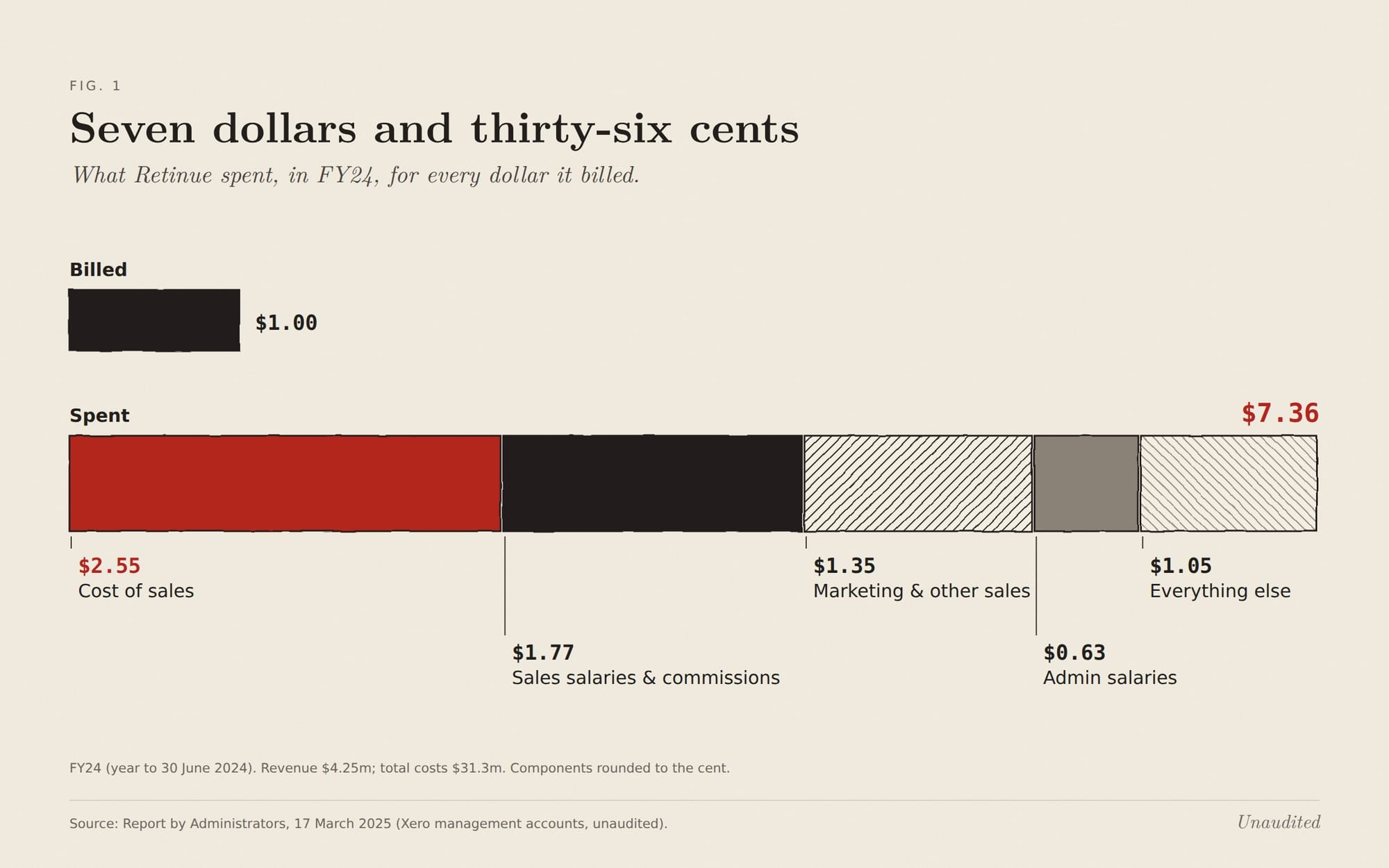
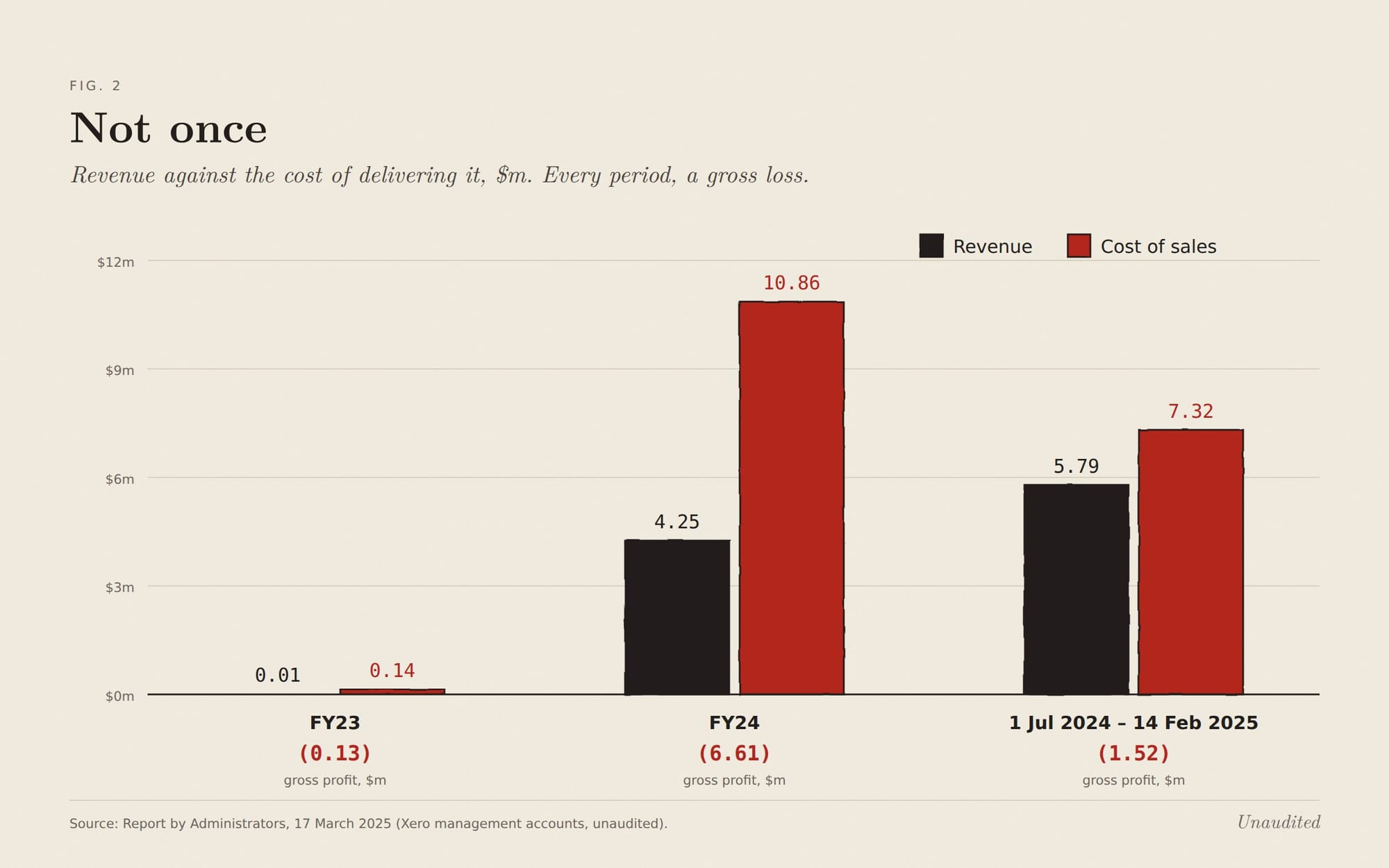
In FY24, Retinue billed $4.25 million. The cost of delivering that work was $10.86 million. For every dollar a client paid, the firm spent about $2.55 providing the service. That was its best-growing year.
In the seven and a half months to February 2025, revenue reached $5.79 million, against delivery costs of $7.32 million. An improvement, in the sense that losing 26 cents on every dollar is an improvement on losing $1.55.
The administrators' summary is dry and final: throughout its trading life, the business did not generate a gross profit.
That was before anyone was paid to sell.
In FY24, sales salaries and commissions came to $7.54 million. The sales team cost 177 per cent of everything the company billed. Add marketing, marketing salaries and other sales costs, and the firm spent about $13.3 million acquiring customers in a year it earned $4.25 million from them. More than three dollars to win each dollar that, once won, cost $2.55 to deliver.
At 30 June 2024, the balance sheet carried $1.18 million in commissions payable. Commission, as Elvis said, was the one thing that was always paid.
Across its whole life, Retinue lost almost $39 million on about $10 million of revenue. That is close to four dollars lost for every dollar billed. On Elvis's peak count of around 1,400 clients, it comes to roughly $27,800 lost per client. At $350 a month, that is more than six years of fees, per client, gone.
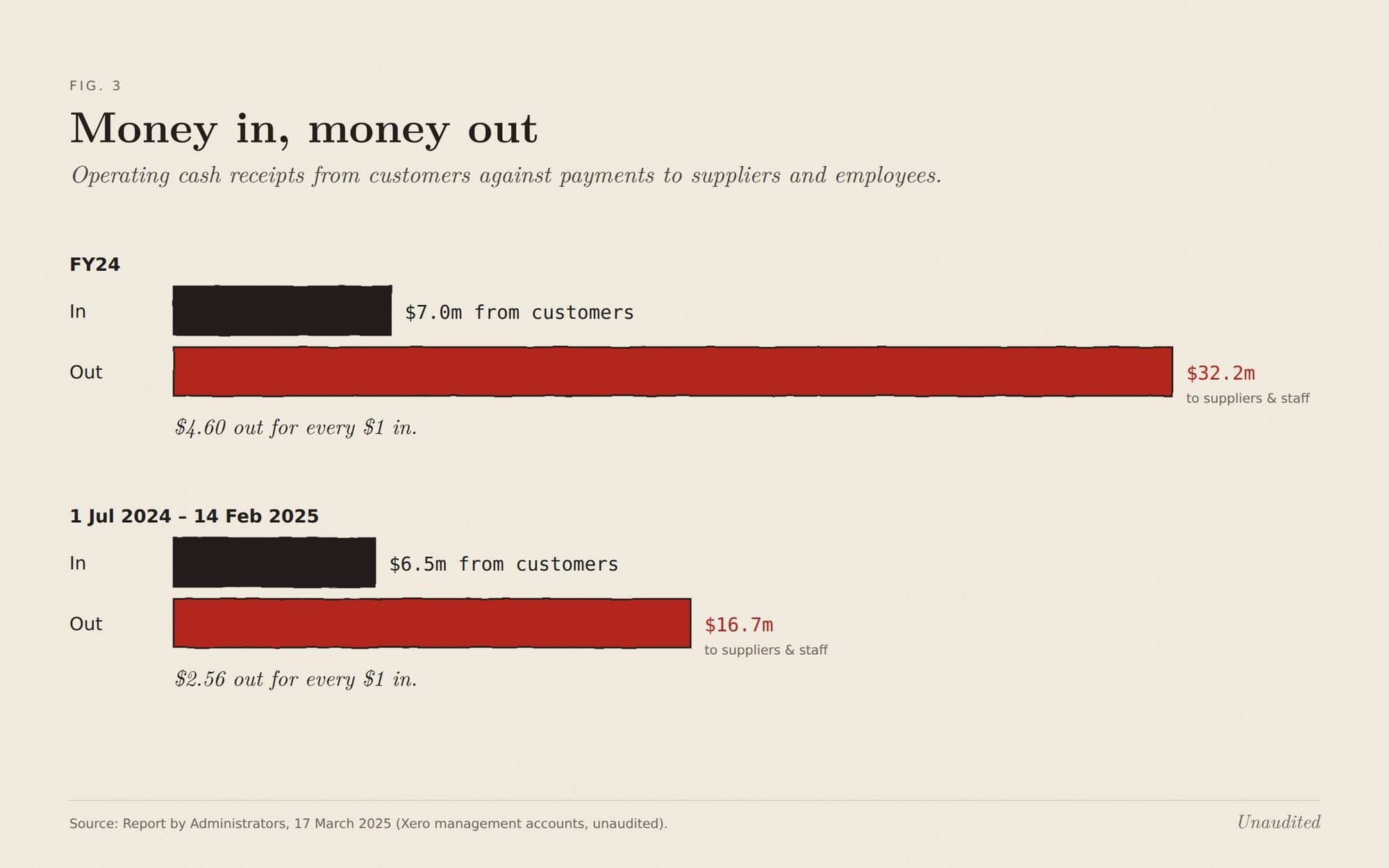
In FY24, customers paid the company $7.0 million. The company paid out $32.2 million.
Somewhere, a slide still says fastest-growing. It isn't wrong. It's just not the whole slide.
The Lender
Businesses that lose four dollars for every one they earn need somebody to pay the difference. At Retinue, that was the chairman.
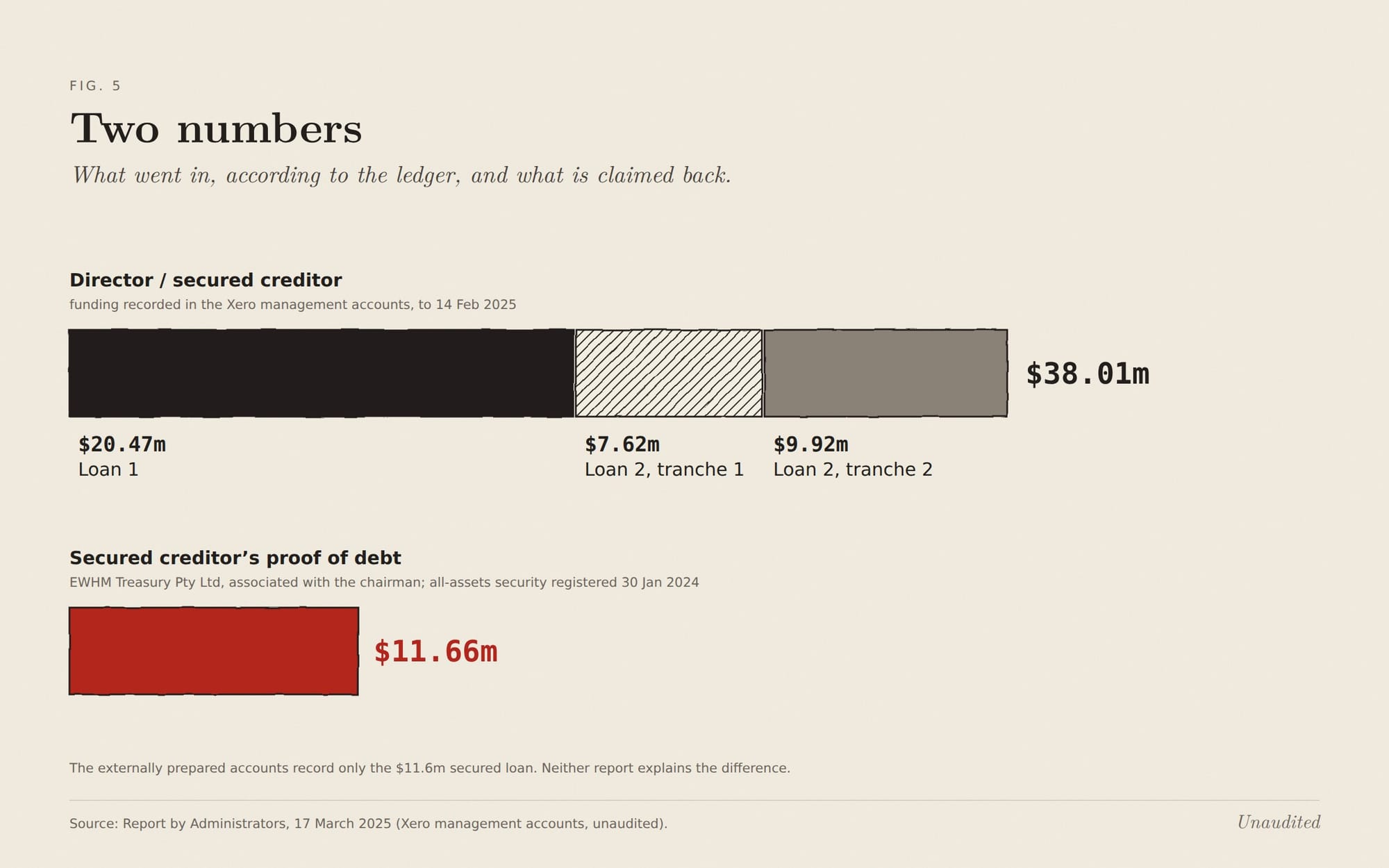
The administrators record roughly $38 million in funding from a director and the secured creditor, EWHM Treasury Pty Ltd, which they note is associated with the chairman. Loan 1 had reached $20.47 million by June 2024. Loan 2 followed in two tranches totalling a further $17.54 million.
On 30 January 2024, EWHM registered a security interest over all of the company's present and after-acquired property. No exceptions.
The administrators date the firm's working capital ratio below 1, meaning current assets could no longer cover current liabilities, from 31 January 2024.
That is the next day.
The security, the administrators say, likely secures money advanced after it was registered. EWHM lodged a claim for $11.66 million. Not $38 million. The externally prepared accounts, the administrators note, record only the $11.6 million loan. What became of the other $26 million or so, whether it was forgiven, converted, sits unsecured or was simply not claimed, the reports do not say. It is a reasonable question. It is one the chairman is welcome to answer.
The loans were not free. Interest expense was $491,638 in FY24 and $1.1 million in the seven months to February 2025, some paid and some capitalised. A company that never made a gross profit paid interest to its owner's lending vehicle.
None of this, the administrators and liquidators have concluded, gives rise to an insolvent trading claim. Their reasoning is worth sitting with. The losses were funded by the director's interests, most creditors were paid within terms until shortly before the end, and he tried to raise capital before running a sale. Their preliminary view is no voidable transactions and no breach of duties.
It is the cleanest possible way to lose $39 million. Nobody else's money went in. Only the chairman's. And the security registered on 30 January 2024 means that, of whatever comes out, the chairman's vehicle ranks first.
Eleven, Thirteen, Fourteen
By late 2024 the secured creditor had decided not to fund any further. The chairman tried equity, debt and a joint venture. When those failed, a broker, Kev Ryan Advisory, ran a sale campaign. The administrators say two parties reached due diligence. Elvis heard that four firms looked at the client book and walked away because they couldn't service it at the price.
The winner was Retinue by Squeeze Pty Ltd.
The Asset Sale Agreement was signed on 11 February 2025. It completed on 13 February. On 14 February, the directors appointed administrators.
Valentine's Day. Nobody sent flowers.
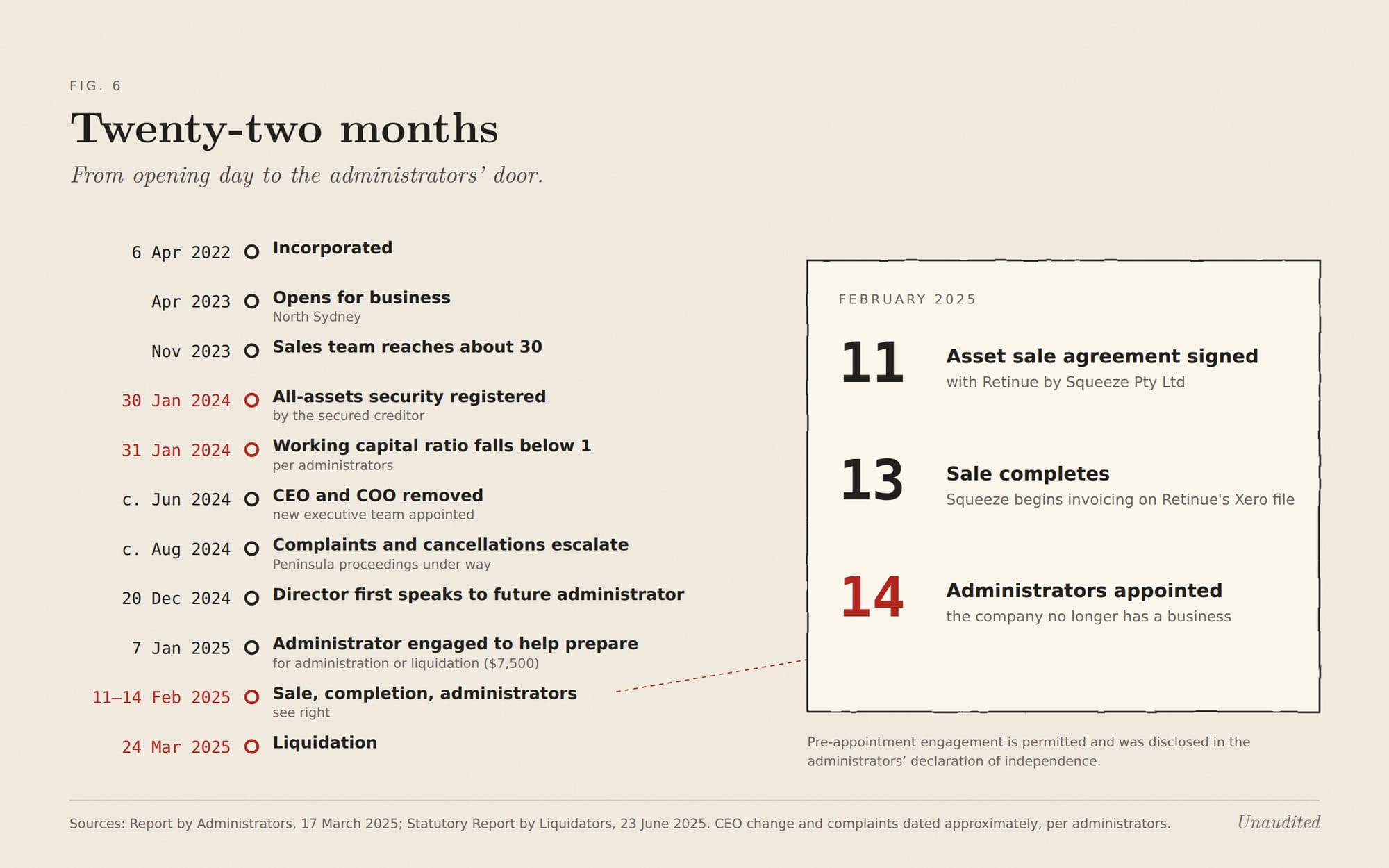
The administrators did not arrive cold. Their own independence declaration records that one of them first spoke to the chairman about the company on 20 December 2024, was engaged on 7 January 2025 to help prepare for administration or liquidation, and was paid $7,500 for that pre-planning. He attended calls on the sale in late January and early February, and on 11 February, the day the agreement was signed, joined a teleconference with the chairman and the potential purchaser.
This is all disclosed. Pre-appointment advice is permitted and common. The administrators found the sale was run professionally through a third-party broker, with the best party selected and reasonable terms given the history of losses. I have no information suggesting otherwise.
But the choreography is worth noticing. The business was out the door before the administrators walked in. What they inherited was a shell with liabilities, and a to-do list for someone else.
The most valuable thing Squeeze bought was the tax agent registration. The administrators warned creditors they might need to adjourn the second meeting and keep the company in administration until the licence transferred, because it was a key asset for the purchaser, at risk if the company went straight into liquidation. Meanwhile, from 13 February, Squeeze invoiced Retinue's clients through Retinue's own Xero file. The administrators spent the following weeks reconciling whose money was whose.
The company was kept alive, briefly, so that its licence could be moved into its buyer.
One Dollar
So what did Squeeze pay for Australia's fastest-growing accounting firm?
The liquidators confirm the upfront payment. It was received in the ANZ account.
It was one dollar.
Not one million. One dollar. $1.00.
The balance is deferred consideration and assumed liabilities, paid in instalments over 37 months, with estimated net proceeds of about $1.5 million. That is why the liquidators expect the liquidation to run another three to four years. The creditors' recovery depends on the buyer being around long enough to pay it. Elvis says Squeeze has since been out raising about $12 million.
And the $1.5 million, when it comes, flows to the secured creditor first.
Here is the rest of the queue.
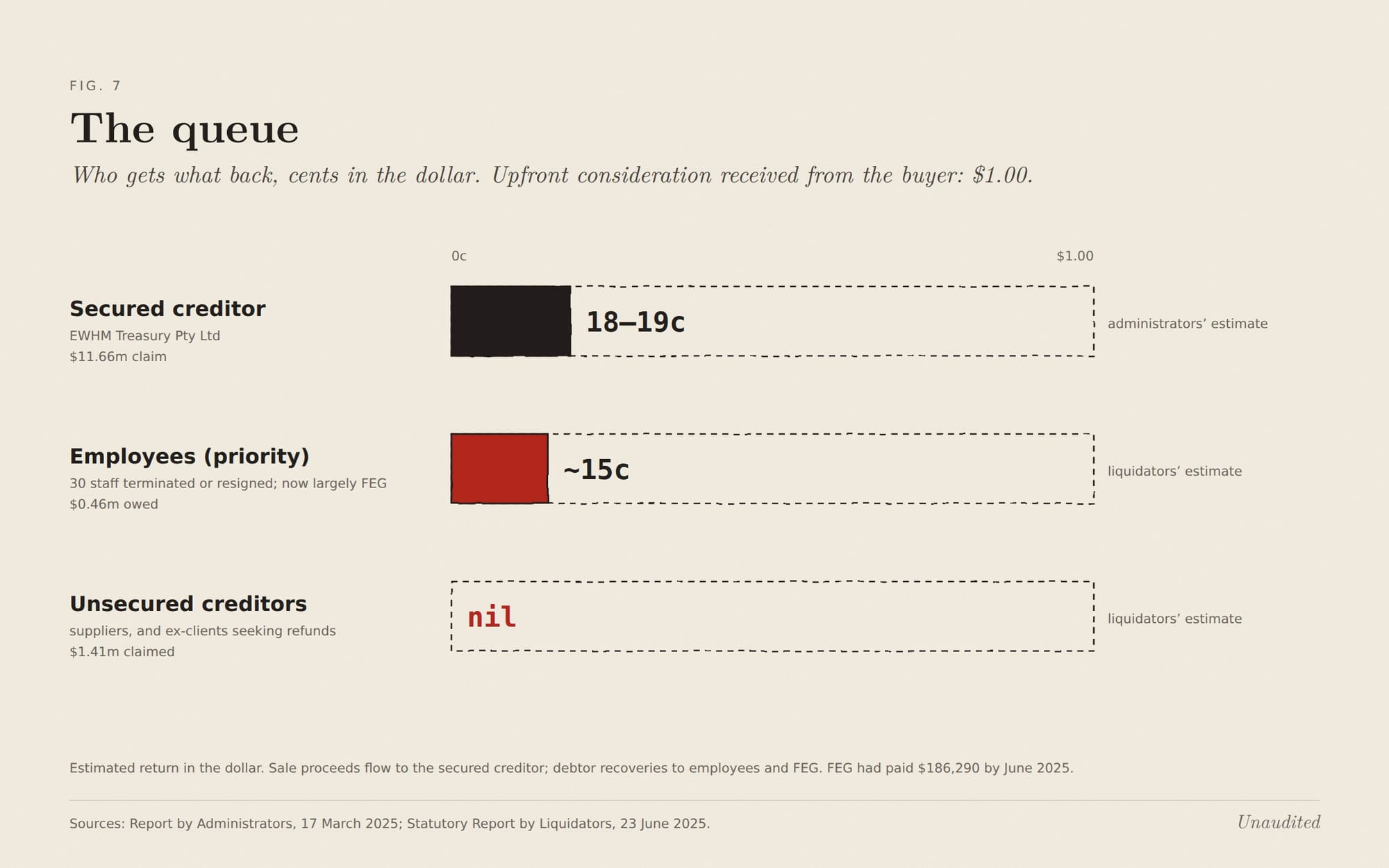
Fifty-nine people worked for the company before the sale. Twenty-nine went to Squeeze. Thirty were terminated or resigned. Their unpaid entitlements come to about $460,000, most of it pay in lieu of notice. Their priority dividend is estimated at around 15 cents in the dollar. The Fair Entitlements Guarantee, which is to say the taxpayer, had already paid out $186,290 by June 2025.
TOA Global, which supplied the 120 offshore staff, has claimed $877,000, having drawn on its bond. The administrators noted a significant invoice processed just before the contract was terminated, which requires further investigation.
The unsecured creditors, suppliers and former clients seeking refunds among them, are expected to receive nothing.
Nil cents in the dollar, for businesses that signed up to have their books done properly.
What Was Left
Liquidations have a way of revealing what a business really was.
The iPhones went to a reseller for about $20,000. The laptops and monitors went to a specialist recovery firm. The bond on the North Sydney office was drawn down by the landlord.
And then the liquidators sold the client opportunity list extracted from the company's Salesforce database. They also secured the company's leftover credits on Bark, a lead-generation marketplace, and began negotiating with an interested buyer.
The accounting firm died. The prospect list survived it. In the end, the most saleable thing Retinue owned was the sales machine.
There were other threads. Since August 2024, the company and the chairman had been defending NSW Supreme Court proceedings brought by Peninsula over alleged breaches of restraint-of-trade provisions attached to the sale of his previous business. Legal fees came to about $940,000. The chairman told the liquidators that the litigation, and his insurer's failure to reimburse costs, placed a substantial burden on the new business and contributed to its failure.
$940,000 is about 2.4 per cent of the losses.
And there was a line in the administrators' report that I read three times. On reviewing the company's ATO portal, the most recent IAS and BAS returns appeared to be outstanding.
An accounting firm, behind on its own BAS. (The liquidators later found no tax debt on the portal. But still.)
The Numbers Were There
It would be easy to call this hubris and leave it there. Elvis does, more or less. So did plenty of former staff, in places that are easy to find.
But the more uncomfortable reading is that none of it was hidden. The staff saw it. They did the sums in the kitchen. They told management it wasn't sustainable, loudly and often, and asked for the milestone meetings to stop. The then CEO told the board profitability would cost much more than budgeted. The head of tax asked what the plan was for a negative gross margin and got a sales pitch. The clients voted with their complaints, then with their cancellations, then by refusing to pay the administrators.
Everyone who needed to know, knew. What they lacked was not information.
It was someone willing to take their foot off the accelerator.
Somewhere in North Sydney, there is still an accountant who would have looked at this business in April 2023, said nothing for a long while, and asked to see the numbers.
They would have been the least fun person in the room. They would also have been the only one who was right.
Right of Reply
Mr Edward Mallett, EWHM Treasury Pty Ltd, Retinue by Squeeze Pty Ltd, the administrators and liquidators of Retinue Accounting Pty Ltd, and any former director, officer, executive or individual who considers themselves referenced in this article are invited to correct, clarify or add context to anything set out above. That includes the difference between the $38.01 million in related-party funding recorded in the company's management accounts and the $11.66 million claimed by the secured creditor, the total consideration payable under the Asset Sale Agreement and the progress of the deferred payments, and any matter drawn from the recollection of the company's former head of tax and accounting.
Responses will be published in full and without editorial amendment, subject only to law and the privacy of third parties.
This right of reply remains open indefinitely, which is some way beyond the thirty-seven months the purchaser has to finish paying for the business.
Sources and method
Sources. The Report by Administrators to creditors of Retinue Accounting Pty Ltd dated 17 March 2025, including the administrators' declaration of independence, relevant relationships and indemnities; the Statutory Report by Liquidators dated 23 June 2025; notices published by ASIC; and a recorded interview with Elvis Sehovic, former Head of Tax and Accounting at Retinue, published on The Ryan Tan Show in November 2025. No confidential, privileged or non-public information has been used.
The financial figures. Revenue, cost of sales, expenses, cash flows, funding and balance sheet figures are reproduced as reported by the administrators, who drew them from the company's Xero management accounts. The administrators state that those accounts are unaudited, that statutory accounts for FY23 and FY24 had not been received, and that the externally prepared accounts differ from the management accounts, in particular in relation to related-party loans. Figures are therefore reproduced as reported and not as audited results.
The derived figures are this masthead's arithmetic. The $7.36 spent per dollar billed is total FY24 costs (cost of sales plus operating expenses, $31.3 million) divided by FY24 revenue ($4.25 million). The component figures in Fig. 1 are rounded to the cent. The figure of about $56,800 a day is the accumulated loss of $38,926,325 divided by the 685 days from 1 April 2023 to 14 February 2025, and includes losses incurred before trading began. The loss per client uses Mr Sehovic's recollection of a peak of about 1,400 clients, which is not a figure disclosed in either report. None of these is a finding or a company disclosure.
Mr Sehovic's account. Statements attributed to Mr Sehovic were given by him on the record in a recorded interview and reflect his recollection. They include his account of the sales floor, the commission structure, client numbers, staff workload, the fee of about $350 a month and a meeting at which the company's margin was discussed. Where the administrators' or liquidators' reports address the same matter, that is identified in the text. Where they do not, his account has not been independently verified. Mr Sehovic now leads accounting and tax at The Polyglot Group, which provides accounting services. No payment or consideration passed in either direction.
The funding and the security. The loan balances, the registration of an all-present-and-after-acquired-property security interest by EWHM Treasury Pty Ltd on 30 January 2024, the association between that entity and Mr Mallett, the working capital ratio and the interest expense are reproduced as reported. The administrators' preliminary view is that the security is valid. The administrators and liquidators have expressed the preliminary view that there are no grounds for an insolvent trading claim, no voidable transactions and no breach of directors' duties. The difference between the funding recorded and the amount claimed is not explained in either report. This masthead does not assert what explains it, and no inference of impropriety should be drawn from its being noted.
The sale and the pre-appointment engagement. The dates of signing, completion and appointment, the pre-appointment engagement of one of the administrators from 7 January 2025 and the $7,500 fee are drawn from the administrators' report and their declaration of independence, where they were disclosed. Pre-appointment advice of this kind is permitted and common. The administrators found that the sale was run professionally through a third-party broker, that the best party was selected, and that its terms appeared reasonable in the circumstances. This article makes no suggestion to the contrary.
The $1.00. The upfront payment of $1.00 is reproduced from the liquidators' report, which confirms its receipt. The total consideration under the Asset Sale Agreement also comprises assumed liabilities and deferred payments over 37 months, with estimated net proceeds of approximately $1.5 million. This article does not assert that the business was sold for one dollar in total.
Returns to creditors. Estimated returns are those of the administrators and liquidators as stated in their reports. They are estimates, not declared dividends. The priority return to employees was estimated by the administrators at 11 to 15 cents in the dollar and by the liquidators at around 15 cents.
Taxation. The administrators noted that the most recent IAS and BAS returns appeared outstanding on the ATO portal at their appointment. The liquidators subsequently reported that the portal disclosed no outstanding tax debt. Both are reproduced as reported.
The litigation. The NSW Supreme Court proceedings brought by Peninsula entities are described only as the administrators describe them, as a commercial contractual dispute concerning alleged breaches of restraint-of-trade provisions. They are allegations. No finding has been made, and none is suggested. Mr Mallett's view that the litigation contributed to the company's failure is reproduced as he gave it to the liquidators.
The purchaser. No allegation is made against Retinue by Squeeze Pty Ltd or its related entities. Any reference to its capital raising reflects Mr Sehovic's account and has not been independently verified.
Disclosure
This article is independent commentary, opinion and analysis on a matter of public interest, based on the sources identified above. Derived figures are identified as the author's arithmetic and depend on the figures reported. Characterisations of strategy, culture, sequence, incentives and corporate approach are the author's honest opinion, formed on reasonable grounds, and are published in reliance on the protections afforded to honest opinion, fair comment and publication in the public interest under the Defamation Act 2005 (NSW) and its state equivalents.
No allegation is made, and none should be read, that Mr Mallett, EWHM Treasury Pty Ltd, Retinue Accounting Pty Ltd, Retinue by Squeeze Pty Ltd, the administrators or liquidators, any related entity or any individual has engaged in misleading conduct or breached any law, regulation, code, professional standard or duty. All retain the presumption of lawful conduct unless a competent authority determines otherwise.
Nothing here is financial, investment or legal advice. Retinue, Squeeze, Xero, Salesforce, Karbon, FYI, Bark, TOA Global and PlayStation are trademarks of their respective owners, used for identification and commentary only.
The author holds no interest in any entity named in this article and received no payment or consideration from any party in connection with it. The author interviewed Mr Sehovic for The Ryan Tan Show and has no commercial relationship with him or with The Polyglot Group.